


Welcome to the Weekly Writ, a round-up of the latest federal and provincial polls, election news and political history that lands in your inbox every Thursday morning.
Reading this in your email inbox and having trouble viewing any of the charts? To optimize them for your device, click/tap the charts or view them on thewrit.ca.
If you can’t get an MP to cross the floor, getting them to leave the floor entirely isn’t a bad consolation prize.
It came as a bit of a surprise on Tuesday when Prime Minister Mark Carney announced a list of his new Senate appointees that included Conservative MP Richard Martel. Partisan Senate appointees went (largely) out of style during Justin Trudeau’s years in office as he set up an independent nomination panel. But plucking an MP out of the House is a throw-back — the last Senate appointee to come directly from the House of Commons was Mac Harb, who Jean Chrétien appointed to the Senate in 2003.
But that was from his own caucus. Martel is the first sitting MP to be named to the Senate by a prime minister from a different party since Brian Mulroney appointed Liberal MP Marcel Prud’homme to the Senate in May 1993, just a few weeks before Mulroney was out of the prime minister’s office. This will be the first byelection caused by the appointment of an MP to the Senate by a prime minister from a different party since Claude Wagner was named to the Senate by Pierre Trudeau in 1978.
So, in short, this doesn’t happen very often.
It’s a little tricky to interpret this departure. If Martel was simply leaving politics, it would be a rather normal resignation. But he’s not leaving politics — he’s a Conservative moving to the Senate at the request (or the acquiescence) of the Liberal prime minister. He’s going to sit as an Independent in the Senate, at least for the time being, but this is somewhere between a floor-crossing and a simple resignation. It isn’t a huge blow to Pierre Poilievre’s leadership, but it’s also not an endorsement. Martel has decided that he’s done with being a Conservative MP, but not with politics entirely. He likes his future better as a Senator than as a member of Poilievre’s caucus.
For the Liberals, this is one fewer vote on the opposition benches. Liberal MP Nate Erskine-Smith also made his resignation official yesterday, so there are four vacancies in the House. The government has 171 votes (172 with the Liberal Speaker) against 167 opposition votes. When Steven Guilbeault, Cathay Wagantall and Alexandre Boulerice make their resignations official, the Liberals will be down to 170 votes (171 with the Speaker) against 165 opposition. That’s a decent cushion for their majority, so there isn’t necessarily a rush for the Liberals to fill those vacancies.
Unless, of course, they want to pad their majority even more. The Liberals are expected to win the byelections in North Vancouver—Capilano (Jonathan Wilkinson’s former seat), Beaches—East York (Erskine-Smith), and Laurier—Sainte-Marie (Guilbeault), which would bump them back up to 173 votes (174 with the Speaker). The Conservatives should hold Yorkton—Melville (Wagantall) and the Bloc Québécois should hold Saint-Hyacinthe—Bagot—Acton (Simon-Pierre Savard-Tremblay), putting the opposition back up to 167.
But the Liberals have a decent shot in Rosemont—La Petite-Patrie (Boulerice) and, perhaps, an even better chance in Chicoutimi—Le Fjord, the riding helpfully vacated by Martel. If the Liberals flip both of these, they will have 175 votes (176 with the Speaker) to just 167 for the opposition. That kind of majority is looking pretty solid.
As I pointed out on Tuesday, the model thinks the Liberals are the very narrow favourites in Chicoutimi—Le Fjord. But it looks like it could be a true toss-up. It was a three-way race in the April 2025 election, with Martel taking 34.1% of the vote to the Bloc’s 31.2% and the Liberals’ 31.1%. It will not take a big swing in support for either the Liberals or the Bloc to take this seat.
Martel was a draw for the Conservatives, at least when he first arrived. This part of Quebec in the Saguenay-Lac-Saint-Jean region has been surprisingly swing-y, despite its nationalist reputation. The Bloc won Chicoutimi in its first election in 1993. But it went to the PCs’ André Harvey in 1997 and went to the Liberals when Harvey ran under that party’s banner in 2000. The Bloc won it back in 2004, but only managed between 39% and 45% of the vote in the 2004, 2006 and 2008 elections.
Like most of Quebec, the riding went to the New Democrats in 2011 as part of the Orange Wave as support for the Bloc (and Conservatives, and Liberals) dropped. But the Liberals were able to take the seat back in the 2015 election, beating out the NDP by a narrow 31.1% to 29.7% margin. The Liberals’ Denis Lemieux did not finish his term, however, and that set the stage for a byelection in 2018.
Richard Martel was a star candidate for the Conservatives. He coached the Chicoutimi Saguenéens of the QMJHL for most of the 2000s, winning coach of the year in 2005. He took 52.8% of the vote in the 2018 byelection, with most of his support coming from the Bloc when they were at a particularly low point shortly after Martine Ouellet’s ouster as leader. Martel held off the Bloc, now under Yves-François Blanchet, by small margins in 2019 and 2021.
His vote dropped in the 2025 election as the Liberals surged from just 18% in 2021 to 31% in 2025 in Chicoutimi—Le Fjord. Without Martel, the Conservatives might lose more of the vote. But that’s not a given, since Martel under-performed fellow Conservative candidates in neighbouring ridings. Regardless, the Conservatives could be hard-pressed to hold this seat as their support in the province has slipped since the last election — certainly enough to put a three-point margin of victory into doubt.
Much will depend on who the three contending parties can recruit as their candidates, as this is the type of riding that can swing more based on who is on the ballot. There is also the timing of the byelection to take into consideration. The Saguenay-Lac-Saint-Jean is expected to move pretty strongly to the Parti Québécois in October’s provincial election, but the results of provincial votes in Quebec do not seem to have much relation to federal results of late. The PQ easily won the provincial byelection in Terrebonne in March 2025 just a month before Mark Carney’s Liberals won the seat by a single vote, an outcome that was improved upon in the Terrebonne federal byelection held earlier this year.
We now have seven byelections slated to take place within the next six months or so (we’re still waiting on the resignations of Boulerice, Wagantall and Guilbeault, but all are expected to occur before the end of August). Chicoutimi—Le Fjord was decided by the smallest margin in the last election out of those seven seats and so it should be the most hotly-contested. Rarely do we see a true three-way race, with so much at stake for all three parties.
Can the Liberals pad their majority and demonstrate that Quebec is still a key part of their electoral coalition? Can the Bloc take advantage of the Conservatives’ slippage in the polls and win back a nationalist region of the province? And do the Conservatives still have what it takes to win a close race in Quebec? Whenever these byelections take place, this’ll be the one to watch.


Now, to what is in this week’s instalment of the Weekly Writ:
News on which parties ended 2025 with money in the bank, as well as a glimpse at the fundraising of minor parties. Plus, we have news of comings and goings in the Ontario Liberal leadership race, the slate of candidates in Quebec, the B.C. Legislative Assembly and the right-side of the political spectrum in Manitoba.
Polls raise more questions than they answer in Atlantic Canada, plus we have new federal polls, views of British Columbians on the southern vs. northern pipeline routes and the state of the race in Toronto. Also, how many people can name the leader of the NDP?
#EveryElectionProject: The Manitoba provincial election of 1914.
The first Weekly Writ of the month is free to all subscribers. If you haven’t already upgraded but would like to receive full access to the Weekly Writ every Thursday, as well as to the detailed regional and riding-level federal vote and seat projections, please upgrade your subscription today!
NEWS AND ANALYSIS
Which parties still have election debts to pay off?
The 2025 annual returns have begun to be filed and uploaded by Elections Canada, giving us a look at where each of the parties ended what was a rollicking election year.
We already know how much money each of the major parties raised last year through their quarterly filings — $48 million by the Conservatives, $29 million by the Liberals, $6 million by the New Democrats and $2 million by the Bloc Québécois — but the filings go into more detail about how much money the parties still had in the bank at year’s end.
They also show how much of their election loans remain on the books.
According to the filings, the Conservatives took out a $30 million loan last year, of which $17.7 million was paid off by the end of 2025. That left just over $12 million to pay back at the beginning of 2026.
The Liberals took out $27 million in loans and have already paid off all but $4 million of them. The Greens, too, took out a loan worth $750,000 and have paid most of it off.
As the Greens did not obtain 2% of the vote in the last election, they haven’t had to file quarterly since Q2 2025. This means that their annual filings represent our first look at the Greens’ fundraising in a year. They show that the party raised $3,341,000 last year from 11,725 contributors.
The Greens reported fundraising of $1.9 million in their quarterly filings in the first half of last year, so this suggests the Greens raised another $1.4 million in the last half of the year. That matches their fundraising in the back half of 2024, so it isn’t a bad number. For the year as a whole, this was the most the Greens have raised since the last election year in 2021, when the party took in $3.5 million.
The Greens ended the year with $309,000 still in the bank. Their filings show they maintained salaries and benefits worth $1.2 million, so the poor election showing does not seem to have entirely gutted their offices.
Their offices, of course, pale in comparison to those of the other parties. The Conservatives spent $10.9 million on salaries and benefit last year, while the Liberals spent $9.1 million. The Conservatives had more expenses than revenues in 2025, but nevertheless ended the year with $8.2 million in cash on the balance sheet. The Liberals were also in the black at $2.2 million.
As of writing, the annual returns for the New Democrats had not yet been filed. (They are routinely tardy.)
The Greens weren’t the only smaller party that had their fundraising totals revealed in these annual filings. Last year was the first year that the Greens did not have to file quarterly, as they had always previously crossed the 2% threshold since the filing requirements were adopted over 20 years ago. But other small (smaller?) parties have long only had to file annually. These filings are our only glimpse at the finances of these minor parties.
Here is where fundraising stood for those that have had their returns posted:
Christian Heritage Party
$469,368 raised from 1,032 donors
The CHP spent about $234,000 on salaries and benefits, indicating that the party, unlike some of the other small parties, has employees (and perhaps a salary for the party’s leader).
Reforge Party (formerly the United Party)
$255,276 raised from 594 donors
Membership revenue suggests the party has between 400 and 500 members.
Marxist-Leninist Party
$110,579 raised from 225 donors
The party’s biggest expense was $46,407 spent on office rent and equipment.
Centrist Party
$16,095 raised from 53 donors
The party spent $400 on “polling and research” in 2025, the same amount as in 2024. I wonder what that bought.
Marijuana Party
$0 raised
The Marijuana Party had $88.87 in the party’s bank account when it was deregistered in October.
ELECTION NEWS BRIEFS
CERJANEC OUT - The Ontario Liberal leadership field has decreased to four candidates after the withdrawal of Ajax MPP Rob Cerjanec. Fundraising data suggested that Cerjanec was not keeping pace with his rivals. As of earlier this week, Navdeep Bains was leading the way with $310,000 from donors who gave at least $200 to his campaign (Elections Ontario doesn’t post aggregate donations of less than $200 in its real-time disclosures). Lee Fairclough raised $210,000, Dylan Marando had raised $130,000 and Eric Lombardi had raised $120,000. Cerjanec had raised just $90,000, still putting him well below the $150,000 entry fee. Prospective candidates have until July 31 to get into the running, so it is possible that some other contestants could throw their hats into the ring. There has been chatter that Don Valley West MPP Stephanie Bowman, who had endorsed Cerjanec, could try to take his place.
MUSICAL CHAIRS IN QUEBEC - Quebec Premier Christine Fréchette has announced that she will be running in the riding of Trois-Rivières in the next election rather than in Sanguinet, where she was elected in 2022. Fréchette was born in Trois-Rivières and said she wanted to highlight the importance of Quebec’s regions with her candidacy. It’s debatable whether or not Trois-Rivières is more winnable for the CAQ than Sanguinet, which is located in the Montreal suburbs to the south of the island. Meanwhile, Pierre Dufour, first elected with the CAQ in Abitibi-Est in 2018, will be running for the Quebec Liberals. He was booted from the CAQ caucus after demanding he remain within François Legault’s cabinet in order to adequately represent the Abitibi-Témiscamingue region in northwestern Quebec. If the Liberals win the election, one suspects Dufour is banking on being in Charles Milliard’s cabinet if he holds the seat.
BOULTBEE BOLTS TO NDP - Amelia Boultbee, who was elected as a B.C. Conservative in the 2024 provincial election, has joined the governing B.C. New Democrats. Boultbee left the Conservative caucus, then under John Rustad’s leadership, over the expulsion of fellow-MLA Elenore Sturko in October 2025. With Boultbee, the New Democrats now have 48 MLAs in the 93-seat legislature, which gives the party a majority without making the Speaker (who is also a New Democrat) break ties.
DAUDRICH TO KEYSTONE - Wally Daudrich, who finished a close runner-up to Obby Khan in the Manitoba PC leadership race last year, has left the PCs entirely after he was disqualified from the nomination contest for the riding of Turtle Mountain, where the PC incumbent is not running for re-election. Daudrich has switched over to the right-wing Keystone Party and will be the party’s candidate in the upcoming byelection in The Pas—Kameesak.
POLLING HIGHLIGHTS
Some eyebrow-raising polls out of Atlantic Canada
We don’t often get polls out of Atlantic Canada. And maybe that’s a good thing, because when we do they can be a little odd.
This past week, we were treated to the return of voting intentions polling from Narrative Research, which last put out these kinds of numbers in 2024. We also got a new poll out of Nova Scotia from Abacus Data, which has been in the field more regularly.
We’ll start with the Nova Scotia numbers, since we have two sets of data. But there aren’t many similarities between them.
Narrative put the Nova Scotia NDP in the lead with 45% among decided voters (Narrative released numbers without the undecideds removed, so I’ve done it myself for comparison purposes for all of the Atlantic results). The governing PCs trailed with just 29%, while the Liberals were at 23%.
Those are some striking results, considering the NDP had half that support in the 2024 election. They were even more striking when Abacus came out with the PCs at 40%, the NDP at just 31% and the Liberals at 22%. These numbers were virtually unchanged from when Abacus was last in the field in May.
It’s hard to reconcile these two sets of numbers, even if the field dates were different (but not that different). That Abacus has found previous stability in the province suggests that Narrative might be the outlier. The results of the recent byelection in Chéticamp—Margarees—Pleasant Bay, in which the PC vote dropped a little but so did the NDP’s, would suggest that Abacus is probably closer to where things actually stand.
The two polls do agree that the NDP’s Claudia Chender is in good shape. Narrative gave her a 14-point lead over Tim Houston on preferred premier, which might be a bit exaggerated. But Abacus found that Chender’s personal rating was a net +17 (34% positive, 17% negative) while Houston’s was a net -8 (31% positive to 39% negative). Not quite as dramatic, but it does suggest that the Nova Scotia NDP has an asset in its leader. At the very least, it seems fair to say that the New Democrats have made up some ground since the last election. But an outright lead of double-digits? Maybe not.
Some of these question marks extended to the rest of Narrative’s polling in Atlantic Canada.
In New Brunswick, where we recently saw a poll from Porter O’Brien which gave the Liberals a four-point lead over the PCs, Narrative puts the Liberals ahead by 11 points, 41% to 30%, with the Greens at 13%. This isn’t as much of discrepancy, but you have to wonder how Narrative managed to get 9% support for the Libertarian Party, including 19% (after the removal of undecideds) in northern New Brunswick.
Are the Libertarians surging in the province, perhaps replacing the defunct People’s Alliance? It’s a nice theory, except that the PA did extremely poorly in northern New Brunswick. More likely is that there might have been some sort of confusion between the Liberal Party and the Libertarian Party by people taking the poll.
In Newfoundland and Labrador, the governing PCs were two points up on the opposition Liberals, 38% to 36%, with the New Democrats in a strong third with 25%. While that’s a high number for the NDP (it got 8% of the vote in the last election), it’s not unusual for the party to poll better between elections.
Then we get to Prince Edward Island. The last Narrative poll in PEI was not publicly released but was reported by the media in March. It showed the Greens leading with 41%, followed by the Liberals and PCs at 26% and 25%, respectively. The newest poll follows the same trend line but in more dramatic fashion. The poll has the PEI Greens leading with 54% support, with the Liberals at 26% and the PCs at a woeful 18%.
The sample size (147) is small, and Narrative is conducting its polls online now. It used to use live-callers. An online panel in a small geography, like PEI’s, has to be well-calibrated. It’s rare to see online polling for municipalities, for instance, and the Angus Reid Institute never reports its PEI results because its panel is too small there.
We’ll get a test of Narrative’s PEI numbers on Monday when Islanders vote in the Cornwall—Meadowbank byelection. In the 2023 provincial election, the PCs won this seat outside of Charlottetown with 55% of the vote, followed by the Greens at 24% and the Liberals at 19%. Those results were actually quite close to the provincewide results (56% PC, 22% Green and 17% Liberal), so if this poll is picking up something real we should expect to see a big spike in Green support, the Liberals up a little and the PCs down a lot — and I mean a lot.
The next election in Prince Edward Island is scheduled for October 2027, so that isn’t a huge amount of time for Rob Lantz and the PCs to turn things around if their support has actually tanked this much. We can’t expect much other polling out of PEI (and not from anyone else but Narrative), so this byelection might serve as a useful barometer of what is actually happening in the province.
New federal polls show not much new
Just a quick update on the new federal polls published in the last week from Liaison Strategies, Nanos Research and Abacus Data. There’s not much new to report in them, with the Liberals scoring between 41% and 44%, the Conservatives between 32% and 36% and the New Democrats continuing to be a little puzzling with a low of 8%, according to Abacus, and a high of 15%, according to Nanos.
To give you an indication of the lack of movement in these polls, let’s calculate how things have shifted since they were all last in the field. The Liberals averaged 43%, the Conservatives 33% and the NDP 12% in these three polls last time. This time? The average is 43%, 34% and 12%, respectively. Steady as she goes, then.
POLLING NEWS BRIEFS
NEW LEADER, WHO DIS? - Pollara has returned with one of my all-time favourite polling exercises. Pollsters often test how well politicians are known by simply asking respondents if they’ve heard of X politician. Pollara took another approach, asking people to actually fill in the X. When asked who was the leader of the federal NDP, only 12% of Canadians polled could accurately (or semi-accurately) spell out the name “Avi Lewis”. (Pollara was generous, marking responses like “Davis Lewis” and “the husband of Naomi Klein” as correct.) Wrong answers included “Marit Singh” and “Jagneet?”.
The poll also found that only 57% of Canadians could identify Pierre Poilievre (or a close approximation of that name) as the leader of the Conservative Party. Interestingly, that 57% is the same score Poilievre managed in 2023. Marked as correct by Pollara included “Pierre Polisher”, “Poliver (if he’s still in charge?)” and, my favourite attempt at spelling, “Pierre Poulleveviere”. Incorrect responses included “Ford”, “Daniel Smith” and “I know his face”.
These polls are a good reminder that the general population does not pay as much attention to politics as, say, readers of The Writ. When we see polls on the personal ratings of party leaders, it is good to keep in mind that a chunk of respondents, if not most of them, may sometimes be expressing an opinion about a person they do not know much about at all.
B.C. PREFERS SOUTHERN PIPELINE ROUTE - The announcement by Prime Minister Mark Carney (in conjunction with B.C. Premier David Eby and given the thumbs up by Alberta Premier Danielle Smith) that an agreement has been reached that would have a new pipeline head to the west coast via a southern route with its terminus in Vancouver, rather than on the northern coast of B.C., is likely to be well-received by British Columbians according to polling by Pollara Strategic Insights. The survey found that 60% of British Columbians have a positive feeling about the southern pipeline route along the Trans Mountain corridor, with only 23% having negative views. By comparison, the divide was 52% positive to 30% negative for a northern route that would require lifting the tanker ban.
CHOW LEADS IN TORONTO - New polling by Liaison Strategies gives Olivia Chow the lead in Toronto’s mayor race. The incumbent had 49% support in the poll, with councilor Brad Bradford behind at 40% after the removal of undecideds (who numbered 20% of respondents). Since mid-May, Chow’s lead has dropped from 13 points to nine points.
12-MONTH ELECTORAL CALENDAR
July 13: Cornwall–Meadowbank provincial byelection (Prince Edward Island)
July 21: The Pas—Kameesak provincial byelection (Manitoba)
October 5: Quebec provincial election
October 17: New Brunswick Progressive Conservative leadership
Candidates: Daniel Allain, Don Monahan
October 17: Municipal elections in British Columbia
October 19: Alberta referendum
October 26: Municipal elections in Ontario
October 28: Municipal elections in Manitoba
November 2: Municipal elections in Prince Edward Island
November 9: Municipal elections in Saskatchewan
November 14: Federal Green leadership
November 21: Ontario Liberal leadership
Candidates: Navdeep Bains, Lee Fairclough, Eric Lombardi, Dylan Marando
November 28: Nova Scotia Liberal leadership
Candidates: Amanda Mombourquette
Byelections yet to be scheduled
ON - Scarborough Southwest (to be called by August)
AB - Calgary Shaw (to be called by November)
CA - North Vancouver—Capilano and Saint-Hyacinthe—Bagot—Acton (to be called by December)
ON - York—Simcoe (to be called by December)
CA - Beaches—East York and Chicoutimi—Le Fjord (to be called by January)
CA - Rosemont—La Petite-Patrie (resignation pending)
CA - Laurier—Sainte-Marie (resignation pending)
CA - Yorkton—Melville (resignation pending)
Party leadership dates yet to be set
New Brunswick Greens (David Coon announced on June 4, 2026)
(ALMOST) ON THIS DAY in the #EveryElectionProject
Rodmond Roblin’s last ride
July 10, 1914
This was originally published on July 10, 2025.
Manitoba grew tremendously under the leadership of premier Rodmond Roblin. He took up the post in 1900 and, a year later, the census pegged Manitoba’s population at just over 255,000. After Roblin’s Conservatives had been re-elected a third time in 1910, the population of the province had nearly doubled to 461,000.
By 1914, however, Roblin’s grip on the province was growing weaker and the tolerance for the old ways of doing things was waning. Few governments of the day were squeaky clean and Roblin’s government was no exception. His Conservatives weren’t afraid to use public money and public servants for partisan purposes. And, of course, there was an expectation that hefty donations to party coffers would be made by those getting government contracts. Inflating invoices to cover those donations was common practice.
Increasingly, however, voters were tiring of this normalized corruption. They weren’t quite ready to back new parties — it would take the trauma of the First World War to shake voters out of their old habits for good — but they were starting to expect more from their leaders.
The opposition Liberals, reinvigorated under Tobias Norris, vigorously attacked the government’s corruption. A former auctioneer and compelling speaker, Norris had successfully gathered around him opposition elements in the 1910 election — prohibitionists, suffragettes and farmers — and, at a well-attended convention in early 1914, former leader Edward Brown predicted that a Liberal victory was just around the corner and that “the death-throes of the Roblin régime will be spectacular in the extreme”.
In June (in what would prove to be less than two weeks prior to the assassination of Archduke Franz Ferdinand, the event that would spark the outbreak of war in Europe), Roblin dropped the writ on the next provincial election, setting election day for July 10, 1914, nearly four years to the day since his last victory.
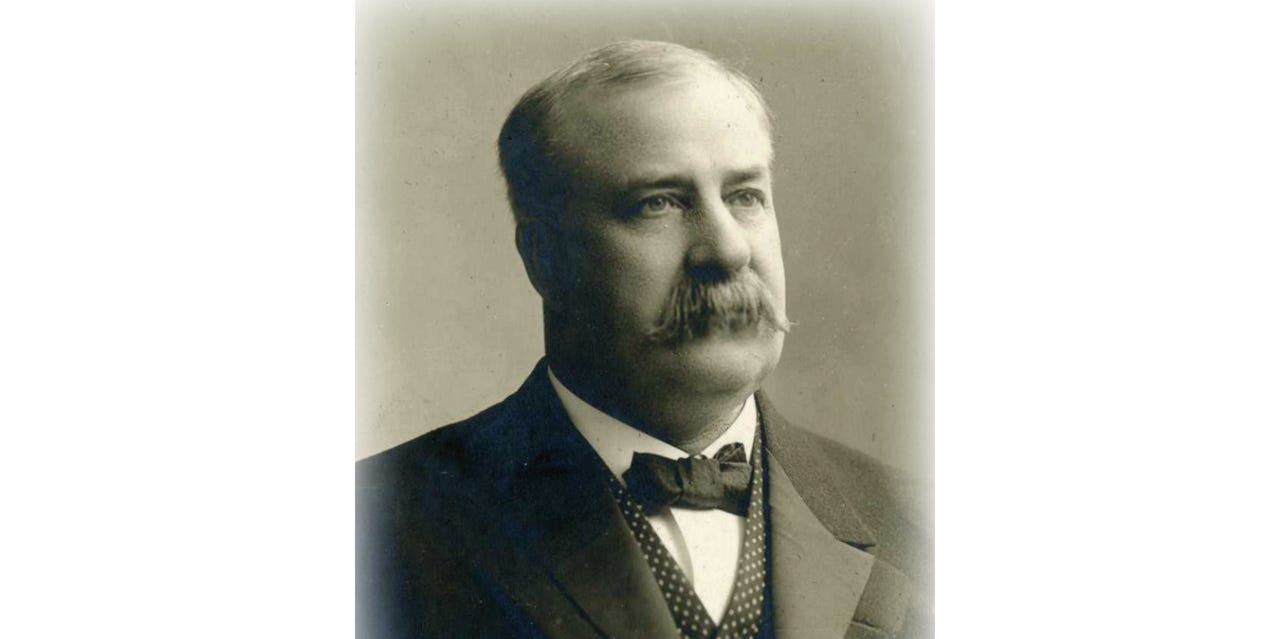
According to the Canadian Annual Review of Public Affairs, “this contest, which had been going on in some degree for months, was not a satisfactory or pleasant one; as in the case of all Canadian Governments, when in power for many years, there were varied charges of corruption and bitter personalities. Sir Rodmond Roblin, who for 14 years had been Prime Minister was not, at the best, a conciliatory opponent or a courteous fighter; his party enemies accepted the guage [sic] with true Western heartiness and the conflict was almost picturesque in the vehemence displayed.”
The Liberals took aim at the Roblin government’s corruption and presented a few platform priorities of their own: “direct legislation” (referendums) to get the support of the influential Grain Growers’ Association, prohibition, English-language compulsory public schooling and a vote on giving women the vote.
“To me it seems that the most serious problem which our people must face and must decide on July 10th,” Norris wrote in his party’s manifesto, “is whether or not domination of public affairs by machine rule shall continue. The Roblin Government, by reason of its long term in office, has become surrounded by an organized gang of political workers who have grown bold in their manipulation of matters pertaining to elections and patronage. As electors I ask you the plain question. How long do you propose to stand for rule by this machine?”
Education, as ever the case in turn-of-the-century Manitoba politics, was a flashpoint in this campaign. Amendments brought in by education minister G.R. Coldwell, designed to make it easier for the government to takeover Catholic schools, were criticized as opening up the doors again to publicly-funded separate schools — a charge especially taken up by the Protestant Orange Order. The government denied this was the case, but the Liberals hammered away at the issue. Norris even claimed that Roblin had personally invited him to support a return of separate schools, which Roblin denied ever happened.
The Conservatives had to run on their record, and it wasn’t a bad one. The province’s infrastructure had been built up over the preceding years, a new Agricultural College (now part of the University of Manitoba) had been founded and Manitoba’s territory had been extended to Hudson’s Bay. The government had also begun construction on a new legislature building that “would be an honour and a credit to the Province”.
“We come with a policy,” he said, “we come with a record, we come with a faith and hope born of conviction that there is a great future for this Province.”
Roblin took his message across Manitoba and over 20 days made stops in Carman, Miami, Stonewall, Emerson, Dominion City, Transcona, Portage la Prairie, Reston, Souris, Brandon, Ste. Rose, Dauphin, Grand View, Swan River, Gladstone, Birtle, Morden and Roland. He wasn’t alone on the hustings, getting assistance from “Dominion” Conservatives, including the Manitoba caucus and future prime minister Arthur Meighen.
In Transcona, Roblin pilloried the “direct legislation” movement as counter to the British tradition and said “I am strongly opposed to the ‘Banish the Bar’ plank as well as Woman’s Suffrage as I look upon them as unworkable fads and not in accord with the best interests of the people.”
Liberal leader Norris also criss-crossed the province, with visits to Ste. Rose, Roblin, Russell, Roseburn, Minnedosa, Elkhorn, Transcona, Winnipeg, Macgregor, Carberry, St. Pierre, St. James, Oakville, Portage la Prairie, Selkirk, Brandon, Boissevain and Rivers.
These two men weren’t the only figures garnering attention on the campaign trail. Nellie McClung toured Manitoba as well, advocating for woman’s suffrage and prohibition and against the Roblin Conservatives. She closed her campaign by addressing a crowd of 5,000 in Winnipeg on the eve of election day.
“I could not sit down when there was a fight like this on in my Province,” she said at one of her events. “I could not be contented with just doing ordinary little things – punching holes in linen and then sewing them up again … Too many men have one set of virtues for private life and another for public use. That is one reason why I hope to see a rebuke administered to the Government.”
Charges of corruption and vote-buying were made by both the Conservatives and the Liberals against each other, but in the end the Roblin Machine managed one more victory.
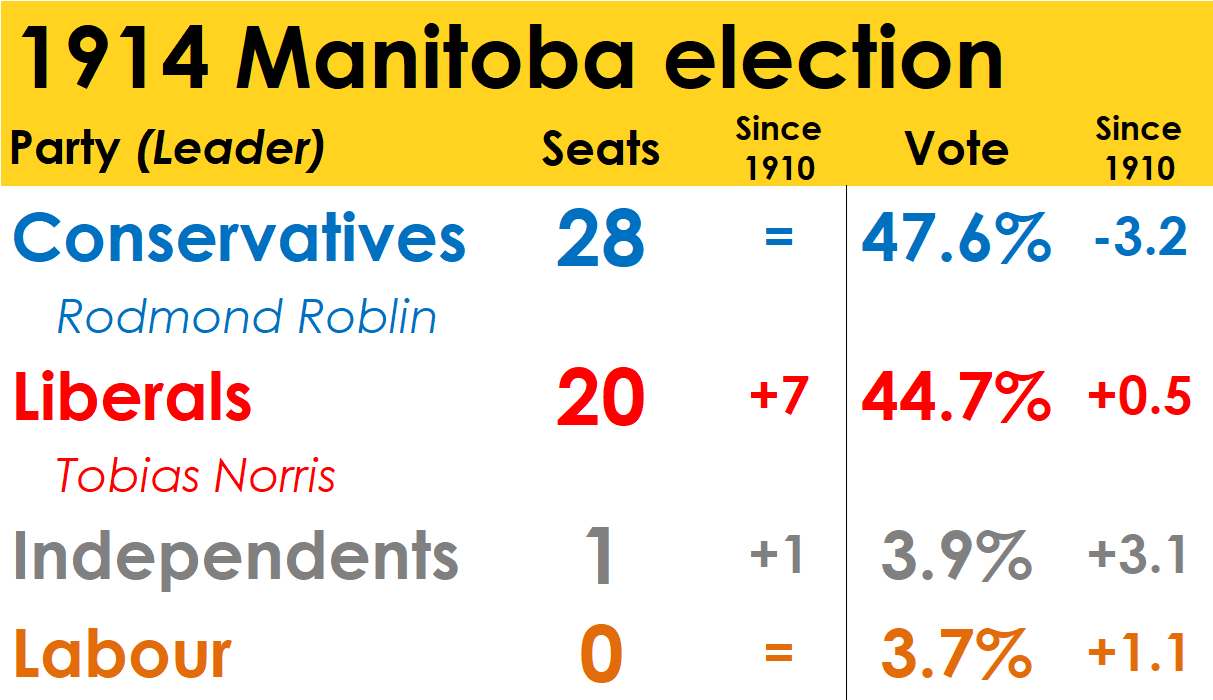
(As voters in Winnipeg received two votes to elect two MLAs for each of the city’s three ridings, the chart above shows the ‘equalized’ vote share for each party, as calculated by Elections Manitoba, which counts each vote in Winnipeg as half of one vote.)
The Conservatives saw their majority reduced in an expanded legislature, but nevertheless won 28 seats and just under 48% of the vote. That was a drop in vote share from the previous election, but enough to hold on. The Liberals increased their holdings from 13 to 20 seats and scored 45% of the vote, while one Independent (Fred Dixon, endorsed by both the Liberals and Labour) was elected in Winnipeg.
There was a divide between Winnipeg and the rest of the province — outside of the capital, the Conservatives and Liberals nearly split the vote evenly, 50% to 48%. In Winnipeg, Independent (often Socialists) and Labour candidates managed around 21% of the vote, with the Conservatives winning the plurality with 43%.
Stung by his reduced majority, Roblin blamed the result on the Orange Order’s baseless fearmongering on separate schools. McClung, meanwhile, took a moral victory out of the result.
“We have fought a good fight and we will keep on fighting; nothing can stop us; no man, not even Sir Rodmond Roblin, can hold his foot against the door much longer,” she said. “The machine is broken, the people will rule, and when we say people we mean both men and women.”
She wouldn’t have to wait long for the end of the Roblin government (or for women’s suffrage). Evidence of corruption in the awarding of contracts for the legislative buildings led to Roblin’s resignation less than a year later. In 1915, the Conservatives would finally go down to defeat at the hands of Norris’s Liberals. But that appetite for something different, for something unlike the politics of before, would take a bite out of the Liberals before long, too.
Shocked that the Marijuana Party only deregistered in Oct 2025; what were they doing since Trudeau legalized weed?