


Welcome to the Weekly Writ, a round-up of the latest federal and provincial polls, election news and political history that lands in your inbox every Thursday morning.
Reading this in your email inbox and having trouble viewing any of the charts? To optimize them for your device, click/tap the charts or view them on thewrit.ca.
We’re going to dive directly into what’s on deck in this edition of the Weekly Writ. Here’s what’s on the docket for today:
News on the ridings that will see their names changed and other amendments the Liberals are making to the Canada Elections Act. Plus, a B.C. Conservative MLA is booted from caucus and two endorsements are made in the B.C. Conservative leadership race.
An update on the federal polls and a look at a new Léger poll that puts the PQ and Liberals neck-and-neck ahead of this year’s provincial election in Quebec. Plus, some new B.C. provincial polling numbers.
#EveryElectionProject: The Ontario CCF chooses its first leader.

The first Weekly Writ of the month is free to all subscribers. If you want to get access to the Weekly Writ every week (and everything else on the site) and you haven’t already, please upgrade your subscription:
NEWS AND ANALYSIS
19 ridings to change names, Indigenous names to be dropped in three
Is your federal riding about to change its name? If you live in one of 19 ridings across the country, that could very well be the case. Some of the changes are arguably good, some are quite plainly bad, and some others raise some questions.
The name swaps were included in a package of changes to the Canada Elections Act being proposed by the Liberal government. The text of the bill can be found here.
The bill includes a series of amendments regarding misinformation, foreign interference and privacy protections. For example, the amendments would make it illegal to knowingly spread false or misleading information intending to impact an election (with exceptions for parody and satire) and adds the use of “deepfakes” that impersonate an electoral official or candidate to the list of prohibited acts.
Also included are measures to protect the personal information gathered by parties and changes to the reporting requirements for fundraising events. For safety and privacy protections (the government’s claim), parties will no longer be required to give five-day advance notice of fundraising events or to post the exact address of the event. These requirements were put into place during the “cash-for-access” controversy during the Trudeau years.
Of particular note to readers of this newsletter (and anyone who tunes into our livestreams of byelection nights), a proposed change will limit constituents to signing the nomination papers of only one candidate, as well as requiring different official agents for each candidate in a riding. This is an attempt to head-off the Longest Ballot Committee. The imposition of unique agents will likely not have that much of an impact — the LBC did this for the Terrebonne byelection and still managed to recruit over 40 candidates — but the signature limits could make it much harder to ever get the list of candidates to the 200+ that we saw in Battle River–Crowfoot last year.
But the riding name changes caught my attention. In all, 19 ridings across the country will have their names changed when the bill passes. Some of the changes are good. Some of them are bad. And some of them are ugly.
First, some general comments on these changes.
We have an entire non-partisan process in place to name these ridings. The electoral boundaries commissions consult widely and go through a multi-stage process of proposing riding boundaries (and riding names), hearing feedback from constituents about the proposals, coming up with new proposals, hearing objections from MPs and then settling on the final map.
It seems against the spirit of this process for MPs to then decide to override the commissioners’ decisions and change the names of their ridings via an act of Parliament. Some of these changes might be good and might be the result of consultation with constituents, but it undermines the non-partisan process if, in the end, the elected MP can change the name of their own accord.
I also can’t help but lament that the net effect of these changes has been that these names got even longer. These 19 ridings contained 446 characters before and they contain 529 now. The changes in Quebec were responsible for most of the increase.
Lastly (and, yes, this is niche), the changes make working with riding data more cumbersome. Ridings are assigned an ID by Elections Canada after the redistribution and that ID never changes. The IDs of ridings are by alphabetical order within each province. Now, the riding names and IDs will no longer be in the same alphabetical order, which can get very annoying when you’re working with different datasets where some are ordered by the ID and others are ordered alphabetically. Won’t someone please think of the spreadsheets!
Alright, let’s get into some of these name changes.
The Good
Cape Spear—Mount Pearl—Paradise
Cape Spear is a headland where no one lives, so it was a little odd to have the entire riding named after it, especially since the riding stretches from Cape Spear on the Atlantic coast to Conception Bay. Mount Pearl and Paradise are the two largest communities in the riding, so elongating the name to include them is fine by me.
The Eastern Peninsulas
Shortened and the vague “The Peninsulas” removed. Any shortening of riding names is generally for the better.
York—South Simcoe
There’s York—Durham and Simcoe North, so perhaps York—Simcoe South would have had greater symmetry, but I’m happy not to have to pronounce New Tecumseth—Gwillimbury.
Saskatoon East
Reasonable people may disagree, but I prefer simple, geographically-understandable names. There’s a Saskatoon South and Saskatoon West, so a Saskatoon East makes more sense than did Saskatoon—University.
Vallée-du-Haut-Saint-Laurent
Mercifully much shorter than its predecessor, describes the riding quite well and is a nice-sounding name (Upper St. Lawrence Valley in English).
Longueuil—Greenfield Park
Greenfield Park is a defined area in this riding, while Charles-LeMoyne isn’t, even if lots of stuff in the riding is named after the founder of Longueuil, Charles Le Moyne. I prefer actual locations to riding names honouring historical figures, but your view may vary.
The Bad
Coast of Bays—Central—Notre Dame
Was Central Newfoundland all that bad? It matched up pretty well with the Central region. Now we have the return of this long name. Though “Coast of Bays” has a Game of Thrones quality to it.
Halifax West—Peggy’s Cove
One of the unfortunate attempts to seemingly make a riding’s name help with tourism. Only a few dozen people live in Peggy’s Cove.
New Brunswick Southwest
Half of Saint John is in this riding, so including it in the name had some symmetry with Saint John–Kennebecasis. There is an argument to be made that St. Croix was not the right name to tack on to it, but New Brunswick Southwest is just so bland, and ignores that Saint John represents a big chunk of its population.
Cariboo—Prince George—Omineca
This one is a bit of a puzzle to me. The Omineca River and Omineca Provincial Park aren’t in this riding, but the riding forms part of the Omineca Region of the B.C. Interior — as so do some other ridings. Why add it?
Argenteuil—Papineau—Des Collines
The new additions refer to regional municipalities that make up the riding, so it isn’t an egregious change. But it’s a lot longer than it was and we already have a riding named Papineau which is in an entirely different location.
Saint-Augustin—Portneuf—Jacques-Cartier
Points docked for lengthening the name of the riding that has had the same name for more than 20 years just to include a town that isn’t in the regional municipalities of Portneuf or Jacques-Cartier and has always been in the riding.
Richmond—Arthabaska—Val-des-Sources
Another lengthening of the name of a long-standing riding to include a left-out town. At least this one won’t change the alphabetical order of the ridings like Saint-Augustin—Portneuf—Jacques-Cartier will.
The Ugly
North York
Maybe it should initially have been North York Centre (though that’s weird) but the new riding of North York only includes a small portion of the old city of North York. It would be like calling one of the six Mississauga ridings “Mississauga” and letting you figure out which one it is.
Jonquière—Hébertville—Pays-des-Bleuets
We had a lovely, short riding name in Jonquière and now we have this. Hébertville is a town of less than 7,000 and, as far as I can tell, most of the actual things named the Pays-des-Bleuets are located in the neighbouring Lac-Saint-Jean riding. Is this another attempt at tourism-through-riding-name?
Rimouski-Neigette—Mitis—Matapédia—Les Basques
This part of the Bas-Saint-Laurent and Gaspésie has long been plagued by overly-long names that try to include as many different locations as possible in them. Rimouski—La Matapédia was an elegant solution, highlighting the two major features of the riding. Now we’re back to this 13-syllable monstrosity.
That leaves me with the three ridings of Brantford—Brant South, Hastings—Lennox and Addington and Sarnia—Lambton, which have been shortened by removing the Indigenous names of Six Nations, Tyendinaga and Bkejwanong, respectively.
The addition of Indigenous place names to a series of ridings was one of the new additions of the last redistribution. Some of them name Indigenous towns or reserves within the riding’s boundaries, some of them use historic names for a location and others include the name of an Indigenous nation. It seems to have largely been the brain-child of the commissioners in Ontario and Quebec as a way to honour Canada’s Indigenous people, and not something that originated from the Indigenous people in question, though their input was sought after the fact.
But I was surprised to see three ridings have their Indigenous place names removed. Not knowing the exact circumstances of all of the changes, however, I don’t want to be flippant about them.
On Tuesday, I reached out to the offices of the three Conservative MPs who represent these ridings (Larry Brock in Brantford—Brant South—Six Nations, Marilyn Gladu in Sarnia—Lambton—Bkejwanong and Shelby Kramp-Neuman in Hastings—Lennox and Addington—Tyendinaga) as well as the First Nations in these ridings (Six Nations of the Grand River, Walpole Island First Nation and the Mohawks of the Bay of Quinte, respectively).
As of writing, I have only heard back from Marilyn Gladu.
Gladu says that, during the redistribution process, she “consulted with the chiefs at that time from Walpole Island as well as the Aamjwinaang and Kettle and Stoney Point First Nations. Since the Aamjwinaang had been part of the riding for over 100 years, I thought they might want to choose a more inclusive or different name. However, they chose not to participate in the public input sessions and written inputs, and so the proposed name remained.”
Prior to the prorogation of Parliament and the calling of the 2025 election, Gladu says “there was a new chief elected for Walpole Island, and he had a huge problem with Bkejwanong being used, so I told him I would have it taken out” but she was unable to do so because of the election. She says that, since the election, there has “been a new chief elected at Walpole Island and when I updated her about the change she was not concerned.”
If I hear back from the other MPs and any of the three First Nations, I will update this in future newsletters.
Once the bill is passed by Parliament, the new names will come into effect after 90 days.
Round-by-round data from the NDP leadership
In case you missed it earlier this week, I was leaked some data from the NDP leadership vote showing how supporters of each candidate ranked the other candidates. The results show that Avi Lewis had broad support across the spectrum, but also that there was a divide between the Lewis camp (more closely aligned with Tanille Johnston and Tony McQuail) and the Heather McPherson camp (more closely aligned with Rob Ashton).

You can read the story and see all the data at the link above.
ELECTION NEWS BRIEFS
B.C. CON MLA BOOTED - Hon Chan, the MLA for the B.C. riding of Richmond Centre, has been booted from the B.C. Conservative caucus after being charged with assault. Chan intends to stay on as an MLA while he fights the charges.
ELLIOTT, FULMER GAIN ENDORSEMENTS - More movement in the B.C. Conservative leadership race took place this past week, as Caroline Elliott earned the endorsement of Darrell Jones, who is withdrawing from the contest. Meanwhile, Yuri Fulmer announced an agreement with OneBC leader Dallas Brodie that would reserve 88 seats for the B.C. Conservatives and five for the right-wing splinter party. Brodie was elected under the Conservative banner but was removed from caucus over her statements on residential school survivors.
POLLING HIGHLIGHTS
Liberals lead in new holding pattern
As discussed in this week’s projection update, the federal parties appear to have hit a new holding pattern in national voting intentions.
New surveys were published this week by Abacus Data, Léger, Liaison Strategies, Nanos Research and Spark. They don’t show any big changes in support for either the Liberals or the Conservatives with four of the five pollsters giving the Liberals a double-digit lead.
The Liberals have between 44% and 48% support in these five polls, with the Conservatives at 30% to 37% and the NDP between 6% and 11%. That’s a pretty broad consensus of the current state of the race with some healthy variation between individual polls.
There aren’t many consistent trends between these five polls, which suggests stability for the Liberals and Conservatives. However, the NDP is up, if marginally, in four of these five polls.
Here are a few other highlights from these polls:
Abacus polled on Pierre Poilievre’s appearance on The Joe Rogan Experience podcast, finding that the Conservative leader’s performance was a net positive. The poll found that, among those familiar with Poilievre’s appearance, 39% had a positive reaction to it against 24% who had a negative one. Those under the age of 60 had an especially net positive reaction, while those over the age of 60 had a net negative reaction. On the whole, it seems like Poilievre going on the podcast won’t hurt him and will likely help a bit, though not among the electorate where he has the most ground to make up.
On the top three issues in Abacus’s polling, the Liberals are either tied with the Conservatives (rising cost of living), hold a small lead (economy) or have a huge advantage (Donald Trump and the U.S. administration). No other issue among those tested by Abacus registered as a top three issue for more than a third of Canadians.
Mark Carney’s positive or approval rating averaged 57% against 32% negative or disapproval in polls by Abacus, Liaison and Léger. Pierre Poilievre’s positive or favourable ratings averaged 38.5% in the Abacus and Liaison polls against 47.5% negative/unfavourable.
Nanos continues to give Carney a lead of 30+ points on the preferred prime minister question at 54.5% to 23%. Avi Lewis should be added to Nanos’s four-week rolling poll starting with next week’s release, but it will take a month before Don Davies is entirely cycled out of the sample.
Liaison found that 22% of respondents had a favourable impression of Lewis, while 17% had an unfavourable one. The majority of respondents were either unfamiliar with Lewis or did not have an opinion. Léger, meanwhile, found that only 32% of Canadians think that the NDP is relevant in Canada’s national political scene, while 43% said it was not.
Quebec’s election turning into nail-biter
A new poll from Léger amps up the potential drama that Quebec’s politics has in store as the next provincial election is just six months away.
The survey shows the Parti Québécois and Quebec Liberals in a tie at 33% apiece, the first time the Liberals have been tied for the lead in a poll in Quebec since 2018. The Liberals have gained 13 points since mid-December, nearly all of it coming at the expense of the CAQ, which now sits at just 9% support. That puts the governing party behind the Quebec Conservatives (15%) and tied with Québec Solidaire.
The PQ still has an advantage due to its 18-point lead among francophones, but the Liberals have been making themselves more competitive among francophones over the last few months. The party was at just 11% in Léger’s mid-December survey, but now stands at 23%. While that doesn’t put much pressure on the PQ in terms of winning the most seats, it does make a majority government less likely — regionally, the PQ is only decisively ahead outside of the Montreal and Quebec City regions.
The collapse of the CAQ is what has caused this tightening race. If you look at the long-term tracking chart from Léger, you can see how the CAQ’s decline first benefitted the PQ and is now benefitting the PLQ.
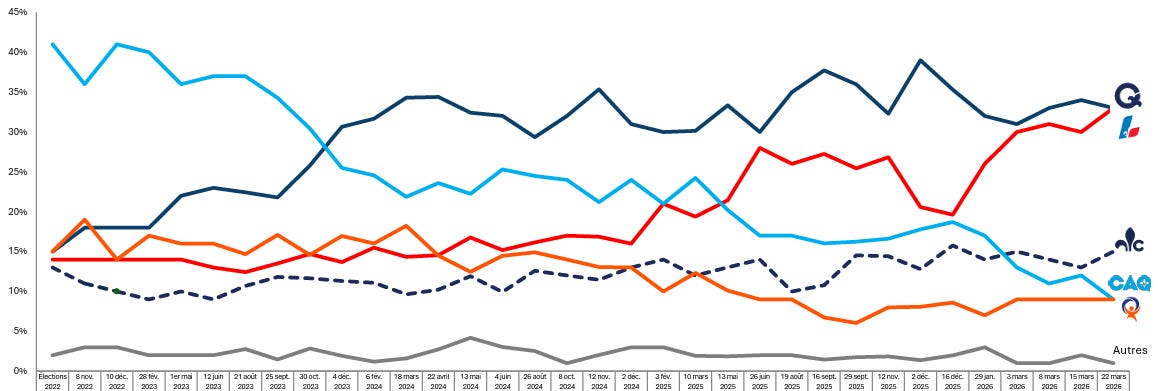
In other words, the CAQ first lost its nationalist vote to the PQ in 2023 and 2024 and then lost its federalist vote to the PLQ in 2025 and 2026. Throughout this time period, the Conservatives have hardly budged while QS has dropped a bit. It’s possible that QS has lost some of its federalist vote to the Liberals and some of its sovereignist vote to the PQ while the Conservatives have shaved off a bit of the CAQ’s more right-wing vote. But the biggest shifts have clearly been CAQ→PQ followed by the CAQ→PLQ that is happening now.
A second poll by Léger commissioned by Christine Fréchette’s campaign, reported by the Journal de Montréal, suggests that the CAQ’s ongoing leadership race could benefit the party once it is over. Fréchette, who is favoured over Bernard Drainville by a nearly three-to-one margin among CAQ voters in this survey, would boost the party to 16% — not nearly enough to save the party but enough to give the CAQ hope of surviving in some form after the campaign is over. Drainville would not boost the party, as under him it would be at 10%, virtually unchanged from its current standing.
Regardless of the outcome of this leadership contest, the march to a PQ victory and a Quebec independence referendum that seemed inevitable only a few months ago is no longer such a sure bet. This election will be important for both Quebec and Canada as a whole, but it’ll also be one to keep an eye on because it is up for grabs.
POLLING NEWS BRIEFS
TIGHT RACE IN B.C. - The Angus Reid Institute published more details from its mid-March quarterly poll, focusing on British Columbia. (Note, the sample is 499 so it is a bit smaller than your usual B.C.-only survey.) The poll found the B.C. Conservatives and NDP virtually tied at 44% to 42%, respectively, with the Greens in third with 9%. The poll found growing discomfort with the government’s approach to Indigenous issues, though it also found that this was not a top issue for many voters.
12-MONTH ELECTORAL CALENDAR
April 12: Coalition Avenir Québec leadership
Candidates: Bernard Drainville, Christine Fréchette
April 13: Federal byelections in University–Rosedale, Scarborough Southwest and Terrebonne
May 11: Municipal elections in New Brunswick
May 30: British Columbia Conservative leadership
Candidates: Iain Black, Caroline Elliott, Kerry-Lynne Findlay, Yuri Fulmer, Warren Hamm, Peter Milobar
October 5: Quebec provincial election
October 17: New Brunswick Progressive Conservative leadership
Candidates: Daniel Allain, Don Monahan
October 17: Municipal elections in British Columbia
October 19: Alberta referendum
October 26: Municipal elections in Ontario
October 28: Municipal elections in Manitoba
November 2: Municipal elections in Prince Edward Island
November 9: Municipal elections in Saskatchewan
November 21: Ontario Liberal leadership
November 28: Nova Scotia Liberal leadership
Byelections yet to be scheduled
ON - Scarborough Southwest (to be called by August)
PE - Cornwall–Meadowbank (to be called by September)
NS - Chéticamp–Margarees–Pleasant Bay (date TBD)
CA - Beaches–East York (potential resignation pending)
AB - Calgary Shaw (resignation pending)
Party leadership dates yet to be set
Federal Greens (Elizabeth May announced on August 19, 2025)
(ALMOST) ON THIS DAY in the #EveryElectionProject
The Ontario CCF’s first leader
April 3, 1942
This was originally published on April 3, 2024.
As the Second World War raged across Europe, North Africa and the Pacific, Canadians sensed that things would not go back to where they were before the war had started — assuming the Allies could win, of course. The trauma of the Great Depression and the demands of the war demonstrated to Canadians that there was a need for a more activist central government, one that would ensure the well-being of everyone. If the government could mobilize massive resources to defeat enemies overseas, why couldn’t it do the same to guarantee a minimum standard of living at home?
This was the moment that the Co-operative Commonwealth Federation had been waiting for, and accordingly the CCF started to surge in some of the first political polls ever conducted in Canada.
Already established in Western Canada, the CCF was having difficulty breaking through in Ontario. But a byelection in the riding of York South provided an opportunity for the party.
The Conservatives had yet to recover from the defeat of R.B. Bennett’s government in 1935. His replacement as leader, Robert Manion, had no success in the 1940 election and the Conservatives went back to the drawing board. Rather than look forward, however, the Conservatives looked back and acclaimed Arthur Meighen, leader and briefly prime minister during the 1920s, as their party chief in 1941.
Assailed on his war record, Mackenzie King was desperate to see his old and hated foe go down to defeat. When a byelection was called in the riding of York South to get Meighen into the House of Commons, the Liberals opted not to run a candidate. To avoid splitting the vote, they left the field open to Joseph Noseworthy, the seemingly long-shot candidate of the CCF.
With a little help from the federal Liberals — though not the provincial Liberals, whose leader, Premier Mitchell Hepburn, backed Meighen — Noseworthy scored an upset victory in February 1942. It spelled the end of Meighen’s comeback attempt, but also created some positive momentum for the Ontario CCF.
The Ontario CCF wasn’t in the best of shape. In the last provincial election in 1937, the party had failed to elect a single candidate and took just 5% of the vote. But with support for the national party rising and fresh off the stunning win in York South, it was decided that the Ontario CCF needed to get better organized. To mark the 10th anniversary of its founding convention, the Ontario CCF decided they would finally name something they hadn’t yet had: a party leader.
A convention was set for April 1942, where the party would decide on platform policy and name its new leader. A total of 17 candidates were nominated for the post, including Noseworthy, future federal NDP leader David Lewis, then-sitting Ontario CCF president Sam Lawrence and Agnes Macphail, the first woman ever elected to the House of Commons.
In the end, all but two declined the nominations. One was Murray Cotterill, the 28-year-old secretary to the Toronto labour council and a stalwart of the CCF Youth Movement.
The other was Edward (Ted) Jolliffe, the vice-president of the provincial council of the CCF. “Tall and slender,” according to media reports, Jolliffe was born in China while his Christian missionary parents were in the country. Also young at just 33, Jolliffe nevertheless had an impressive resume. He had been a Rhodes scholar at Oxford (where he had founded an Oxford branch of the CCF with David Lewis), a journalist and a lawyer, and had twice stood as a candidate for the federal CCF.
Between the two, it wasn’t much of a contest. The delegates gathered at the Carls-Rite Hotel in Toronto, more than 100 strong, and overwhelmingly selected Jolliffe as the first leader of the Ontario CCF. The detailed results were not announced, but “it was learned reliably, however, that the majority was so sweeping as to show almost complete endorsation by the 107 delegates” according to the Canadian Press.

In his victory speech, Jolliffe attacked the Hepburn government, both on the premier’s unpatriotic position on the war effort (he had dismissed the U.S. Navy and predicted that the Soviet Union would be defeated) and his unwillingness to create a social safety net for Ontarians.
“We believe the C.C.F. has the policy and the C.C.F. is the only hope in this province,” he said, citing a previous meeting he had with Hepburn where the fate of those on unemployment relief was discussed. “There was contempt and hatred in his tone of voice,” Jolliffe charged, “hatred and contempt for the unemployed.”
“The time has come, following C.C.F. successes in other provinces and in the federal field, to open a ‘second front’ here in Ontario. And with the help of the workers and the farmers we are going to do it.”
Jolliffe would deliver on his pledge. Before the convention, one of its organizers had confidently predicted that the Ontario CCF could elect 15 candidates in the next election. When it was finally called in 1943, the CCF won 34 seats and formed the official opposition. One of those seats was Ted Jolliffe’s. He ran, and won, in York South.
Will you make a riding forecast for Quebec?