


The Liberals swept all three of the seats up for grabs in yesterday’s byelections, saving their best performance for the riding they were looking to pick up from the Conservatives. But not only did the Liberals make the gain they were gunning for, the Conservatives lost vote share in all three ridings — and, in Chicoutimi—Le Fjord, suffered their biggest loss of support in any federal byelection held in over a decade.
Before getting to last night’s results, let’s get to the latest update of The Writ’s Federal Vote and Seat Projection. The change since last week’s update has been marginal, but the Liberals have now opened up a 12-point lead over the Conservatives and are projected to be leading in 219 seats and win an average of 210, even after taking into account the Conservative tendency to beat their own polls.
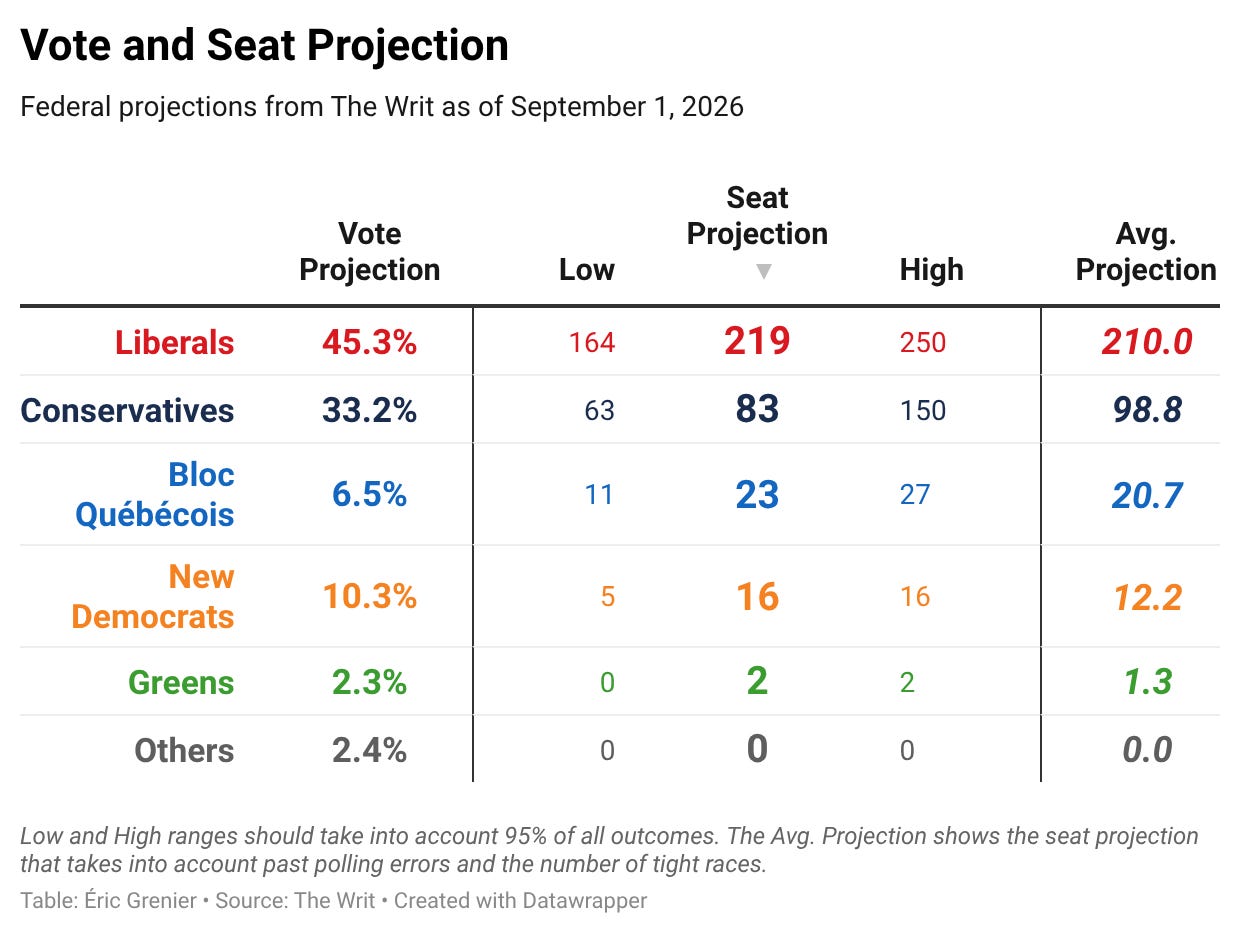
The Conservatives are projected to be leading in just 83 seats and win fewer than 100 seats on average, while the New Democrats are still very much in the running to achieve recognized party status as they lead in 16 seats and win an average of 12.2 in the model’s 10,000 simulations. Polling since the termination of trade negotiations with the U.S. suggests that the Liberals and Mark Carney have gotten a small bump, but the Liberals might be reaching their ceiling in public support as it is. What we haven’t quite figured out, however, is where the Conservative floor is located.
That question becomes all the more pressing when we take a look at what happened in the three byelections last night.
The respectable turnout (40% in Beaches—East York, 42% in Chicoutimi—Le Fjord and 46% in North Vancouver—Capilano) in these contests suggests that voters were engaged — or about as engaged as one might expect voters to be at the end of August just a week before the Labour Day weekend.
The Liberals’ Daniel Gobeil prevailed in Chicoutimi—Le Fjord, taking 51.3% of the vote in the party’s best performance in this part of Quebec since Pierre Trudeau’s near-sweep of the province in 1980. The Liberals were up 20.2 points, an astonishing result in a deeply francophone and nationalist region. The gain was even more dramatic than the party’s 9.7-point bump in Terrebonne earlier this year and the increase was so big that the Liberals actually earned more total votes in this lower-turnout byelection than they did in the 2025 general election.
Caroline Dubé of the Bloc Québécois finished with 32.9%, an increase of only 1.7 points and still down from the party’s showing in this seat in 2019 and 2021. The NDP and Greens were largely unchanged at 2% and 0.7%, respectively.
But it’s the drop in support for the Conservatives that is perhaps the most shocking. Régis Gaudreault captured just 12.5% of the vote, a stunning loss of 21.6 percentage points.
While some of that exodus could be blamed on the departure of former Conservative MP Richard Martel, who was a high-profile junior hockey coach in Chicoutimi before he made the jump to federal politics, this score is well below the normal cruising altitude for the Conservatives even before Martel came along. In 2015, when Stephen Harper’s government went down to defeat, the party still managed nearly 17% of the vote in Chicoutimi—Le Fjord. When the Conservatives could only win five seats in Quebec in the 2011 election, 25.3% of voters supported the party here. The Conservatives also easily cleared the 20% threshold in the 2006 and 2008 elections. This result is not just an under-performance of Martel’s results. It’s an under-performance of the Conservative baseline and the worst result for the party here since 2004.
The Liberals’ Tanveer Shahnawaz secured 55.7% of the vote in Beaches—East York, a significant drop of 12.1 points compared with Nate Erskine-Smith’s performance in this Toronto riding in 2025. Much of that vote appears to have gone to Shannon Devine and the New Democrats, who were up 18.9 points to 25.8%.
It seems likely that the resignation of Erskine-Smith, who was one of the more progressive members of the Liberal caucus, liberated some progressive voters in Beaches—East York to return to the NDP. Avi Lewis and the New Democrats appear to have put more effort and resources into Beaches—East York and the jump in support shows that these efforts paid off. This was the best score for the NDP in this riding since 2015, when they were the incumbents.
The Conservatives were down eight points to 15.5%, while the Greens were up 0.4 points to 1.7%.
For fully interactive charts, tables and maps, head to The Writ’s website:


Finally, in North Vancouver—Capilano the Liberals’ Braeden Caley won with 58.6% of the vote, a small drop of 1.2 points. The Conservatives’ Stephen Curran took 29.2%, down 4.5 points from his own performance in the last election. The Greens’ Shelley Luce upset the NDP’s Stephen Tweedale for third place with a gain of seven points, taking 8.7% to the NDP’s 3.1%. That was a small drop of 1.1 points for the NDP.
So, what to make of these results?
For the Liberals, the night has to be graded very well. The loss of support in Beaches—East York was big, but Erskine-Smith’s 67.8% in the last election was among the best results for the Liberals anywhere in the country — a high bar to meet. The party also held its vote in North Vancouver—Capilano. The win in Chicoutimi—Le Fjord ensured the night can only be seen as a success, but it is the dramatic nature of the victory that mitigates what would have otherwise been a somewhat disappointing result in Beaches—East York. Of course, a win is a win and a solid 30-point victory is nothing to sneeze at.
The New Democrats should be very pleased with the result in Beaches—East York, which surpassed expectations. But the poor showings in Chicoutimi—Le Fjord and, especially, North Vancouver—Capilano point to the result in Beaches—East York being the result of hard work and the resources that were poured into the riding. If the New Democrats were organically growing, they would have done better in North Vancouver—Capilano rather than lose vote share. The party captured between 16% and 20% of the vote in this seat in the 2019 and 2021 elections under Jagmeet Singh, so a 3.1% result anywhere in the B.C. Lower Mainland should put a bit of a sour note on the NDP’s evening. Nevertheless, Lewis demonstrated that his message can resonate when it’s backed up by organization. Plus, coupled with the result in University—Rosedale earlier this year, he’s shown that the NDP isn’t doomed to under-perform in byelections, as had been the case over the previous decade.
The Bloc can’t take much from the result in Chicoutimi—Le Fjord. Their vote held up but at a level that’s too low to contend for the seat. In Terrebonne, the party had shown that in a polarized race it could corral the anti-Liberal vote, even if it wasn’t enough to take the seat. In Chicoutimi—Le Fjord all the Bloc did was get its base out.
The Greens, meanwhile, showed some life in North Vancouver—Capilano. In the context of where that party has been in the last few election cycles, that’s a good silver lining.
But there aren’t any silver linings for the Conservatives, especially when you look at how last night’s results compared with the Conservatives’ other byelection results since 2015.