


Welcome to the Weekly Writ, a round-up of the latest federal and provincial polls, election news and political history that lands in your inbox every Thursday morning.
Reading this in your email inbox and having trouble viewing any of the charts? To optimize them for your device, click/tap the charts or view them on thewrit.ca.
Two more MPs have been added to the list of those intending to resign in the coming weeks, increasing the total number of byelections Prime Minister Mark Carney will have to call within the first two years of his mandate to 13, the most called by any prime minister in such a short amount of time in more than 75 years.
Last week, Conservative MP Larry Brock announced he would be resigning his seat of Brantford—Brant South in September and return to practicing law, citing frustration with the limited ability that opposition members have to influence legislation. Earlier this week, Liberal MP Shaun Chen announced he would resign his seat of Scarborough North effective August 15 due to health problems he’s had since being involved in a car accident last year.
This means that within six months of Brock’s resignation, Carney will call his 13th byelection since the April 2025 general election. There could be even more if other MPs decide to step down between now and then.
First there was the byelection in Battle River—Crowfoot that was called in 2025 to provide Conservative leader Pierre Poilievre a seat. Three more byelections were held earlier this year in April to fill the vacancies left by the departures of Bill Blair and Chrystia Freeland, as well as to re-run the invalidated result in Terrebonne. Another three byelections are being held on August 31 in Beaches—East York, Chicoutimi—Le Fjord and North Vancouver—Capilano. That increases the total to seven.
Between now and next April, byelections will also have to be called to fill vacancies in Saint-Hyacinthe—Bagot—Acton (already vacated), Laurier—Sainte-Marie, Rosemont—La Petite-Patrie and Yorkton—Melville, in addition to the byelections in Brantford—Brant South and Scarborough North. That makes a baker’s dozen.
That feels like a lot of byelections. And, you know what? It is.
The chart below shows the number of byelections held by the number of days since the last general election going back to 1949. The thick dark red line shows the current pace Mark Carney’s government is on, with the future eighth to thirteenth byelections shown at the last possible date they can be called. (If you’re viewing this in your email inbox, clicking on the chart below and opening it in your browser will make it easier to read.)
By August 31, with seven byelections under his belt, Carney has already called the most byelections in the shortest amount of time since 1954, when prime minister Louis St-Laurent called his 10th byelection shortly after his 1953 election victory. But at some point between now and his 13th byelection call, Carney will surpass the 1953-1957 St-Laurent government for the most byelection calls within the first two years, making him the prime minister who has called the most byelections in that time frame since 1950.
(It’s unlikely, though, that he’ll surpass the previous St-Laurent government of 1949-53, which called 13 byelections within the first 12 months and upped that total to 21 byelections before the end of the following year. MPs died in office at an alarming rate back then, and when they didn’t die they were often given patronage appointments as judges or senators.)
Is it merely coincidence, or is there something behind this high number of calls? That’s hard to tease out.
Barring an early general election, the 13 byelections that Carney will call within his first two years will be more than all but a few past governments over the last 75 years have called within their full four- or five-year mandates.
The only past Parliaments to hold more byelections throughout their tenure — let alone over the first two years — since St-Laurent were those presided over by John Diefenbaker in his only majority government (1958-62), Pierre Trudeau (1974-79), Stephen Harper (2011-15) and Justin Trudeau (2015-19).
What those all have in common are that there were majority governments — which Carney has now secured — that were either at the tail end of a party’s time in office (Trudeau in 1974-79, Harper in 2011-15) or followed a change of government (Diefenbaker in 1958-62, which came shortly after the PCs’ upset 1957 victory, and Trudeau in 2015-19).
It might suggest that a large number of resignations occur either when a party appears on course for a defeat or when a new government has been installed and there might not be much appetite for those newly on the opposition benches or outside of cabinet to stay there for a full term.
But there is also an element of coincidence at play. Some of the 13 byelections are partly of Carney’s own design. Bill Blair and Jonathan Wilkinson were removed from cabinet and given cushy ambassadorial landings. Chrystia Freeland was effectively demoted and clearly was not part of Carney’s future plans. Richard Martel in Chicoutimi—Le Fjord was offered a Senate post.
Nate Erskine-Smith in Beaches—East York is a bit of a gray area, as he was excluded from cabinet but clearly also had his own intentions in mind with his (eventually aborted) attempt to run for the provincial leadership of the Ontario Liberals.
But most of these resignations were not Carney’s doing. Pierre Poilievre lost his seat and needed a new one. Two Conservative MPs have decided they want to retire from politics (Cathay Wagantall in Yorkton—Melville and Brock). Two other opposition MPs (Simon-Pierre Savard-Tremblay in Saint-Hyacinthe—Bagot—Acton and Alexandre Boulerice in Rosemont—La Petite-Patrie) have opted to run in Quebec’s provincial election in October. The Terrebonne byelection was a court decision. Steven Guilbeault in Laurier—Sainte-Marie resigned from Carney’s cabinet on principle. And Chen’s resignation is due to health issues.
So, it’s a confluence of factors that have put Carney into this historically unusual position — and one of those factors is his own government’s machinations. But, regardless of the reasons, Mark Carney has been dropping more writs more quickly than anyone in over 75 years.
And he has a decent chance of doing something that St-Laurent did not manage to do despite his penchant for calling byelections: pick up a seat from the opposition.
HOW TO ADD THE WRIT TO YOUR PREFERRED SOURCES
If you’ve been using Google recently, you might have noticed they have changed their search function quite dramatically, often highlighting AI-generated responses. But Google also now has a feature called “preferred sources”, which will rank more highly those websites you trust. If you trust The Writ (and I hope you do!) and have a Google account, you can add The Writ as a preferred source by clicking on the button below and checking the box next to the site’s name:


Now, to what is in this week’s instalment of the Weekly Writ:
News on second quarter fundraising for the federal parties and in B.C., plus lots of updates on leadership races across the country and news on the calling of three provincial byelections in Ontario.
Polls have some rough numbers for the Conservatives federally. Plus, the PQ leads a stable race in Quebec and we have new surveys out of Ontario, Toronto and Vancouver.
#EveryElectionProject: The Conservatives aim to end an “orgy of extravagance” in New Brunswick.
Lastly, a programming note. Barring a surprise, there will be no posts from me next week. I’ll be back with a projection update either on the 24th or 25th. Thanks for your understanding!
The first Weekly Writ of the month is free to read for all subscribers of The Writ, but if you’d like to get the full newsletter every Thursday, plus gain access to the federal vote and seat projections, please upgrade your subscription — and thanks!
NEWS AND ANALYSIS
Conservatives top fundraising, but are losing steam
The federal fundraising figures for the second quarter of 2026 show the Conservatives are still the fundraising kings, but their crown is looking a little tarnished as the Liberals have upped their money-making game under Carney.
The Conservatives raised $5.1 million during the months of April, May and June from just over 33,000 individual contributions. While that outpaced the other parties, this number marked the worst second quarter for the Conservatives since 2022, when donor dollars were being directed to the then-ongoing leadership contest that resulted in Poilievre’s victory.
The Liberals, meanwhile, put up their best second quarter outside of an election year since 2016. The party raised $4.4 million from just over 33,000 contributions. Over the course of the first six months of the year, the Liberals have raised $11.2 million, their best start to any year on record with the sole exception of 2025.
While the Conservatives are still raising the most money, they are no longer dominating the field. Poilievre’s average quarterly fundraising lead over Carney’s Liberals has been $1.3 million. His average quarterly lead over the Liberals when Justin Trudeau was leader was $6.5 million. That means that, on an annualized basis, the Conservatives are raising about $5.2 million more than the Liberals. That’s a lot of money, but that annualized lead was $26 million before Carney came along.
The New Democrats raised $1.2 million from nearly 15,000 contributions in the second quarter, which suggests that the fundraising prowess Avi Lewis demonstrated in the leadership contest has not yet had much bearing on the NDP’s ability to raise money. While his haul over his first three months as leader is within the norm for the party, this second quarter was nevertheless worse than six of the NDP’s last seven second quarters.
The Bloc Québécois raised just $221,000 from just over 1,000 contributions, their worst second quarter since the pandemic when donations dried up for all parties. However, with a provincial election on the calendar this year the Bloc might be having difficulty attracting donor dollars from the limited pool of sovereignists that is also being tapped by the Parti Québécois.
ELECTION NEWS BRIEFS
TWO CANDIDATES FOR GREEN LEADERSHIP - The federal Greens have their final slate of candidates for the party’s leadership, which will be determined on November 14. The apparent frontrunner is Mike Morrice, who was the MP for Kitchener Centre before he was narrowly defeated in the 2025 election. Against Morrice is Nira Dookeran, who has been active in the Ottawa area for the federal and Ontario Greens for years and has put her name forward as a candidate six times. She ran in Ottawa South in the last election, taking just under 1% of the vote.
TRIO OF ONTARIO BYELECTIONS - Premier Doug Ford has set September 3 as the date for three provincial byelections in Ontario in the ridings of Hamilton East—Stoney Creek, York—Simcoe and Scarborough Southwest. The first two ridings were won by the PCs in the last election, while Scarborough Southwest was won by the New Democrats’ Doly Begum, who has since been elected as a Liberal MP in the federal byelection held earlier this year. The closest race of these three in 2025 was in Hamilton East—Stoney Creek, where the PCs beat the Liberals by 10.5 points. But Scarborough Southwest is also expected to be competitive.
OLP SLATE FINALIZED - The final slate of candidates for the Ontario Liberal leadership has been finalized, with two-term Don Valley West MPP Stephanie Bowman throwing her hat into the ring. The race also had a brief candidacy from Vikram Handa, who dropped out about a week after announcing a bid. The contest pits two MPPs (Bowman and Lee Fairclough) against two previously unelected candidates (Dylan Marando and Eric Lombardi) and former MP and cabinet minister Navdeep Bains, who is widely considered the frontrunner.
BC CONS EDGE OUT NDP IN FUNDRAISING - The B.C. Conservatives narrowly edged out the B.C. New Democrats in fundraising for the second quarter. The Conservatives raised $1,146,000 to the NDP’s $1,115,000. The Greens came in third with $228,000 raised. Both the NDP and Conservatives raised significantly more than they did in the second quarter of 2025, when the NDP raised $701,000 to the Conservatives’ $350,000.
FORMER PC RUNS FOR NS LIB LEADERSHIP - The Nova Scotia Liberals will pick their next leader on November 21 from a slate of two candidates: Richmond County warden Amanda Mombourquette and Lunenburg West MLA Becky Druhan. First elected as a Progressive Conservative in 2021, Druhan left Premier Tim Houston’s caucus and cabinet in 2025 over “a difference of principles”. After sitting as an Independent, she crossed the floor to the Liberals earlier this year.
PEI LIBERALS QUICKLY SET DATE - Only a few weeks after past leader Robert Mitchell’s second byelection defeat and subsequent resignation, the PEI Liberals have already set the date to name his replacement. The party will choose its third (ostensibly) permanent leader in four years on October 25, with candidates having until September 4 to declare their intentions and until September 18 to pay the full $25,000 entry fee. The next provincial election is scheduled to be held in the fall of 2027.
POLLING HIGHLIGHTS
Multiple polls put Conservatives below 30%
As I wrote in my projection update earlier this week, the Conservatives have been hit with a bad run of polls. And a few more bad ones have been added to the tally.
A plethora of polls have been published over the last week or so. They come from Liaison Strategies, Abacus Data, Léger/Postmedia, Research Co., Nanos Research, EKOS Research and Spark. We also got a new federal Quebec-only poll from Synopsis Recherche for La Presse.
The polls generally have good news for the Liberals — though primarily because the news is so bad for the Conservatives. The Liberals have between 44% and 48% support in these seven national surveys for an average of 45.6%. The Conservative range, at between 27% and 38%, is very wide. But the average of 30.7% shows how the bulk of these surveys are on the lower end of that scale. Worse, four of these seven polls have the Conservatives below the psychological threshold of 30%.
If the Conservatives are looking for a silver lining of some kind, three of those four polls come from pollsters that don’t report all that often and which didn’t have them in a great position the last time they were in the field anyway. But one or two polls below the 30% mark might be a coincidence. Four is starting to look more like a trend — if not necessarily that the Conservatives are actually below 30%, then at least that the Conservatives are low enough in public support that, with the margin of error, scoring 30% in a survey is possible.
The New Democrats ranged between 8% and 17% in these polls, averaging just over 11%, which again argues for the party being at the lower end of its wide range.
The Synopsis poll in Quebec is yet another survey out of that province showing the Conservatives below 20%, suggesting that the broader negative trend we’ve seen for the Conservatives nationally is also taking place in Quebec. The poll puts the Liberals in the lead in all regions and four points ahead of the Bloc among francophones, which should auger well for their chances of flipping Chicoutimi—Le Fjord. But, it’s worth noting that the Liberals have slipped four points in Quebec since Synopsis was last in the field in June.
For the national trends, the Liberals were either holding or gaining in six of the seven polls, while the Conservatives were sliding in five of seven. The four-point drop for the Conservatives in the Liaison poll is statistically significant, as are the party’s drops in the EKOS, Spark and Research polls. However, those three were last in the field several months ago so we can’t say for certain that the drop is a new development.
Here are a few other things to note from these surveys:
The Liberals retain a towering lead among the oldest cohort of voters surveyed in these polls. Abacus, Léger, and Liaison put the Liberal edge over the Conservatives at between 22 and 28 points among older voters, while Research and EKOS have the lead at over 40 points. With the exception of EKOS, which had the Liberals, NDP and Conservatives tied among those under the age of 35, the other polls give the Liberals a lead of between seven and 10 points over the Conservatives among young voters.
Mark Carney has a lead over Pierre Poilievre on preferred prime minister ranging from 23 points in the Research Co. poll to 36 points in the Nanos survey.
Carney’s approval/positive rating averaged 55% in the Research, Léger, Abacus and Liaison polls, with disapproval/negative impressions averaging 34%. Poilievre, meanwhile, averaged 36% positive/approval/favourable to 48% negative/disapproval/unfavourable in the same polls (minus Léger). Lewis stood at 26% and 32%, respectively, on these measures.
Stable race, PQ advantage in Quebec
With the election call in Quebec only a few weeks away, a trio of new polls show the summer hasn’t had much impact on voting intentions in the province — and that the PQ’s chances of winning a majority remain on a razor’s edge.
The polls come from Pallas Data for Qc125 and L’actualité, Léger for Le Journal de Montréal/Québec and TVA Nouvelles and Synopsis Recherche for La Presse. (As an aside, it looks like the three major pollsters we can expect to see publishing numbers throughout the campaign are all media-sponsored, which is increasingly a rarity elsewhere.)
They all show the Parti Québécois in the lead, followed by the Liberals, Coalition Avenir Québec, the Conservatives and Québec Solidaire — in that order. The PQ’s lead is not towering, but its advantage among francophones gives it an enormous seat advantage. The only question is if it is enough to get them to the 64 seats needed for a majority government.
The PQ scored either 30% or 31% in the three polls, with the Liberals registering between 24% and 27% and the CAQ either 19% or 20%. The Conservatives followed with 13% to 15%, while QS brought up the rear with between 9% and 11%.
The PQ’s support among francophones was between 34% and 37%, giving it a lead of between 11 and 15 points over the CAQ. That’s a big edge and an electorally-decisive one. The Liberals, with between 13% and 19% among francophones, are not yet competitive enough among this electorate to really compete for government. They need to be well over 20% to have a shot.
But that isn’t something new. In fact, these three polls do not show any consistent, significant trend in one direction or another for any of the parties. Compared with when these three pollsters were last in the field, the biggest shifts have been a one-point average gain for the Quebec Conservatives and a one-point average loss for the CAQ.
That the CAQ has either stagnated or lost a little ground over the summer is certainly bad news for Premier Christine Fréchette, who has to appear as a fresh, new face in order to shake off the baggage of the unpopular CAQ government. It’s no coincidence that the CAQ’s advertising and new logo emphasize Fréchette and have the words “Coalition” or “CAQ” nowhere to be found. She’s still within striking distance to put some pressure on Paul St-Pierre Plamondon and the PQ, but she will have to build up a new head of steam to do that. For now, she’s stuck.
As these three polls were all in the field at roughly the same time both in June and August, we can take a deeper look at the regional numbers to try to discern a trend. For the most part, there is little consistency in the regional and linguistic shifts across these three polls, which suggests stability. But a few things stand out:
The Parti Québécois is up between one and five points in the Greater Montreal region, while the Liberals are down between one and six points. While that might be good news for the PQ in the suburbs around Montreal, the party is also down in all three polls in the regions of Quebec, dropping between one and six points. This could make achieving a majority more difficult.
The CAQ has dropped significantly in the Quebec City region in the Synopsis and Pallas polls, but was up only a single point in the Léger poll. While that is not a consensus among the three polls, it does suggest that some weakening for the CAQ in and around the provincial capital has likely taken place.
The PQ’s base among francophones appears rock solid. Both the Synopsis and Pallas polls put the PQ’s support among francophones exactly where it was in June, while Léger had it up only a single point.
Voters appear to see St-Pierre Plamondon and Fréchette as the two main contenders for the job of premier. All three polls show them first and second, respectively, on the preferred premier question with the Liberals’ Charles Milliard in third. On average, St-Pierre Plamondon scores 25% to Fréchette’s 19% and Milliard’s 14%. As those scores include “don’t knows” and “none of the aboves”, the comparison to voting intentions before the distribution of undecideds suggests that St-Pierre Plamondon is about as popular as his party, Milliard is much less and Fréchette is slightly more. She could help drag the CAQ up a few points.
These three polls all put the PQ somewhere around the majority threshold with lots of seats tough to call. So, it’s possible that if these numbers reflect the actual results on October 5 that the PQ could find themselves with a majority government despite having only 30% to 31% of the vote. The party is promising a referendum on independence, but that does not seem to be any more popular than the PQ. The three polls put support for independence at either 28% or 29% and opposition between 59% and 63%. That’s about as low as support for independence has ever been since the emergence of the PQ over 50 years ago.
No matter — in an electorate divided between five parties, each with a chance of winning seats thanks to their regional pockets of support, a majority government is a plausible outcome in Quebec even for a party that can’t garner one-third of the vote.
POLLING NEWS BRIEFS
ONTARIO PCs LEAD BY 8 - Late last month, a poll from Liaison Strategies showed the Ontario PCs trailing the Liberals by five points and Doug Ford’s approval ratings in the toilet. But, once again, a new Abacus Data poll suggests that things might not be so grim for the Ontario premier. The survey found the PCs leading with 40% to 32% for the Liberals, with the NDP trailing with 21%. Granted, that eight-point margin is down four points from when Abacus was last in the field. But it shows the PCs still comfortably in control. The approval ratings for Ford’s government are negative, at 35% approval to 43% disapproval, but do not approach the 70%+ disapproval registered in the Liaison survey. Another poll published yesterday afternoon, this time by Pallas Data for The Trillium, also puts the PCs ahead by eight points with 37% to 29% for the Liberals and 26% for the NDP. With a reduced lead over the Ontario Liberals compared with the 2025 election, the PCs are in a worse position than when they won their third consecutive majority government a year ago. But, they don’t yet seem to be at risk of losing the next election.
ALEXANDER HAS LITTLE IMPACT ON TORONTO RACE - Two new polls of the Toronto mayoral race suggest that the entry of former Conservative MP Chris Alexander into the contest has had little real impact. Liaison Strategies puts incumbent Olivia Chow in the lead with 47%, followed by centre-right challenger Brad Bradford at 40% and Alexander far in the rear at 10%. While both Chow and Bradford have dropped a little from Liaison’s last poll, Alexander’s support has largely come at the expense of the “other” candidates. Forum Research shows a wider lead for Chow at 47% to 32% for Bradford and 11% for Alexander, but there isn’t a previous poll from Forum with which to compare these results. Chris Alexander and Forum Research? Talk about a blast from the past.
SIM LEADS IN VANCOUVER - Though the electorate is divided, incumbent Vancouver mayor Ken Sim remains the frontrunner ahead of the city’s mayoral election this fall, according to a new poll by Research Co. The poll gives Sim (ABC) 22% support among the entire electorate, followed by Kareem Allam (Liberals) and Pete Fry (Greens) at 14% apiece and Colleen Hardwick (TEAM) at 10%. Another 14% are supporting other candidates, while 26% are undecided. After the removal of undecideds, Sim’s lead grows to 11 points over Allam and Fry.
12-MONTH ELECTORAL CALENDAR
August 31: Federal byelections in Beaches—East York, North Vancouver—Capilano and Chicoutimi—Le Fjord
September 3: Ontario provincial byelections in Hamilton East—Stoney Creek, York—Simcoe and Scarborough Southwest
October 5: Quebec provincial election
October 17: New Brunswick Progressive Conservative leadership
Candidates: Daniel Allain, Don Monahan
October 17: Municipal elections in British Columbia
October 19: Alberta referendum
October 25: PEI Liberal leadership
Candidates:
October 26: Municipal elections in Ontario
October 28: Municipal elections in Manitoba
November 2: Municipal elections in Prince Edward Island
November 9: Municipal elections in Saskatchewan
November 14: Federal Green leadership
Candidates: Nira Dookeran, Mike Morrice
November 21: Ontario Liberal leadership
Candidates: Navdeep Bains, Stephanie Bowman, Lee Fairclough, Eric Lombardi, Dylan Marando
November 21: Nova Scotia Liberal leadership
Candidates: Becky Druhan, Amanda Mombourquette
December 5: New Brunswick Green leadership
Candidates:
Byelections yet to be scheduled
AB - Calgary Shaw (to be called by November)
CA - Saint-Hyacinthe—Bagot—Acton (to be called by December)
CA - Rosemont—La Petite-Patrie, Laurier—Sainte-Marie, Brantford—Brant South, Yorkton—Melville and Scarborough North (resignations pending)
ON THIS DAY in the #EveryElectionProject
The province’s first Acadian premier goes down to defeat
August 10, 1925
This was originally published on August 10, 2022.
New Brunswick’s economy was depressed, the government was indebted and unemployment in the province was high. But the previous election had been held five years ago. Like it or not, Premier Pierre-Jean Veniot had to send New Brunswickers to the polls in 1925.
Though parties weren’t officially recognized at the time, Veniot was a Liberal. He was also New Brunswick’s first Acadian premier, taking over from Walter Foster when he resigned in 1923.
On July 17, with the clock running out on the legislature, Veniot set the date for the next election: August 10, 1925.
The biggest issue in the campaign was the Liberal government’s huge hydro-electricity project at Grand Falls. Veniot had always intended on making this publicly-funded project the ballot box issue, stating in 1924 that “we feel the people should have a final voice in the matter before we undertake the real work of development.”
But Veniot grew impatient, and in 1925 his government got the ball rolling on the project, passing legislation that tripled New Brunswick’s borrowing power for the project to nearly $13 million — a huge sum for a province with an annual budget of just $4.1 million at the time.
The opposition cried foul on Veniot’s flip-flop. Shortly before the campaign began, the Conservatives chose John B.M. Baxter, federal MP for Saint John, to lead the party. He would, in the words of the Conservative-friendly Moncton Times, end “the orgy of extravagance” that had occurred under the Liberals.
Baxter charged that the Veniot government was not providing nearly enough details about the feasibility of the project, especially considering its gargantuan cost. The Liberals were rushing into it for no reason — why not wait until the election was over and the people had spoken?
“Are we going to stand,” wondered Conservative candidate Leonard P.D. Tilley, “for another $15,000,000 liability jumped upon us in the last moments of a dying Government? I think the people of this Province, both Liberal and Conservative, will cry, ‘Halt’.”
The Liberals countered that the Conservatives were in hock to the big interests of the lumber and paper industries that dominated New Brunswick. The depression had hit them hard and half of the province’s saw mills had closed. They wanted reduced power rates from the Grand Falls project, but the Liberals would not give them everything they wanted.
As the campaign unfolded, Liberal-leaning newspapers pushed the narrative that Veniot was fighting for the little guy against the heartless logger barons. On the stump, the premier deplored “the brazen attempts to steal away the people’s interest.”
A side issue in the Saint John area was the Liberal government’s introduction of the compulsory pasteurization of milk, a measure that would reduce deaths from tainted milk. The Conservatives, however, attacked the measure, wanting to make people free to purchase what they termed “pure milk” and pledging to “cut out all fads and fancies” in the Department of Health. The Liberals’ health minister defended the policy on the basis that it would save lives.
But something that might have had an even bigger impact on the results was the strain of anti-French bigotry in some quarters of anglophone New Brunswick. The Acadian, Catholic and French-speaking population in the province formed a big minority, but a minority nonetheless. The English Protestant majority in the south was not particularly receptive to the idea of an Acadian premier.
While Baxter himself didn’t attack Veniot’s heritage — he even attempted speaking French to audiences in the north — there was an undeniable “whispering campaign” that passed along the message that ‘a vote for Veniot is a vote for the Pope of Rome’. There were allegations that the Ku Klux Klan, which was an active player in Canadian elections in the 1920s, was involved in trying to influence voters as well.
As Arthur T. Doyle puts it:
“It was one of the great campaigns in New Brunswick’s stormy political history: the posters, the cartoons, the exhaustive canvassing, the countless meetings, the ginger ale and ice cream picnics, the rallies, the oratory, and the endless handshakings. The leaders took full advantage of the fashionable automobile and the modern highway network to criss-cross the province attending massive rallies. Probably no other two New Brunswick politicians had achieved so much exposure in a single campaign … In many small towns they attracted audiences of over 1,000, and in the cities, the crowds sometimes exceeded 2,000 … For the political parties, it was almost certainly the most expensive election ever. While the Liberals said the lumber companies financed the Conservative campaign, the Conservatives said the Grand Falls contractors financed the Liberals. They were probably both right.
Turnout was strong on election day. After the votes were all cast crowds of hundreds gathered outside newspaper offices to await the results. As the numbers rolled in, they were announced over megaphone and written on blackboards in the windows of the offices.
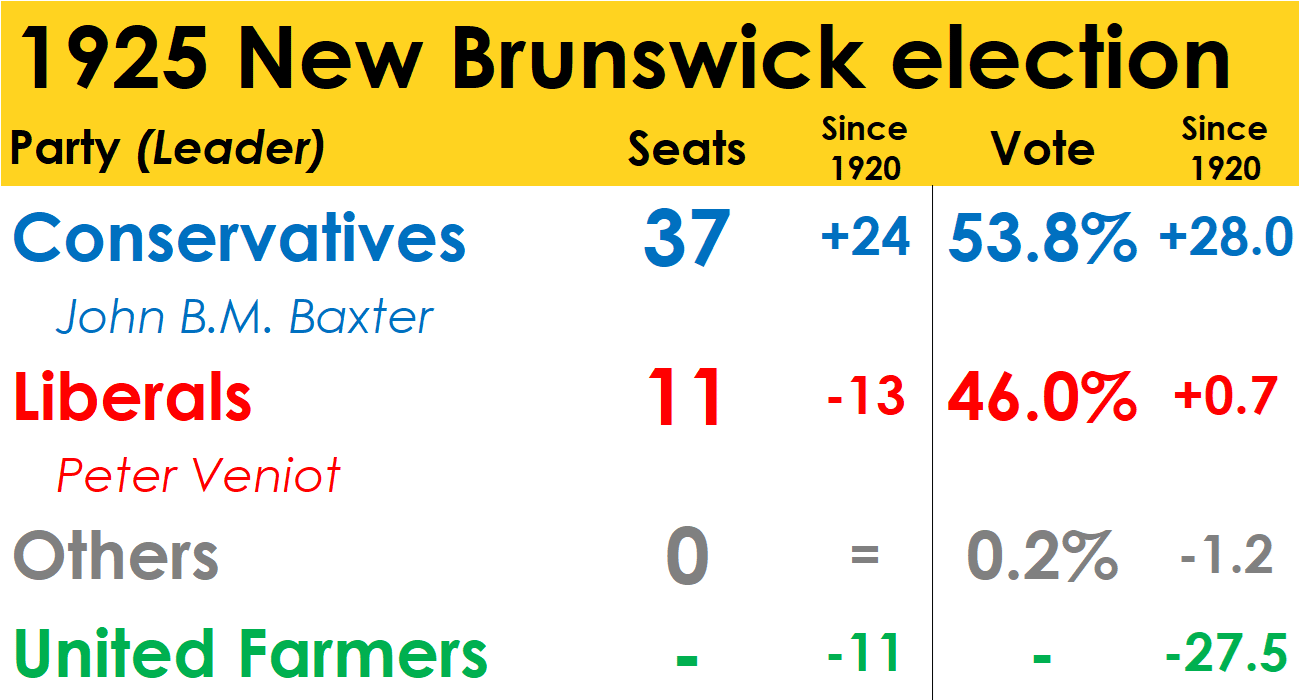
The result was a big victory for John Baxter and the Conservatives, who won 37 seats — an increase of 24 since the 1920 election. The Liberals dropped 13 seats, winning only 11. The United Farmers (who had burst onto the scene in 1920) were wiped out, including the three who ran as supporters of the Liberal government in Carleton county.
While the debate over the Grand Falls project might have dominated the campaign, the map hinted at the linguistic divide that might have been just as decisive.

The only seats the Liberals won came in the counties of Madawaska, Victoria, Gloucester and Kent — areas with big French-speaking Acadian populations. The Conservatives swept the southern anglophone ridings, defeating incumbent Liberal MLAs in places like Moncton, Fredericton and Saint John.
Veniot held on as leader only until 1926, when he made a successful jump to federal politics with Mackenzie King’s Liberals.
Baxter’s Conservatives, meanwhile, would be re-elected in 1930 and the Grand Falls project would be completed in 1931 — after it was sold to a private company.
But, like many Great Depression-era governments, the Conservatives would be turfed in the subsequent election in 1935 by the Liberals under Allison Dysart, a leader who would inspire the political career of Louis Robichaud who, in 1960, became New Brunswick’s first Acadian premier with an electoral mandate of his own.
I knew some federal ridings like Halifax and Ottawa used to elect multiple representatives, but I had no idea that some provinces used to be entirely multi-member districts. It would be really interesting to read more about multi-member districts that were apparently super prevalent in the early 20th Century.
Are the byelections themselves also being called faster (i.e. the time between the seat being vacated & the actual election)?