


Welcome to the Weekly Writ, a round-up of the latest federal and provincial polls, election news and political history that lands in your inbox every Thursday morning.
Reading this in your email inbox and having trouble viewing any of the charts? To optimize them for your device, click/tap the charts or view them on thewrit.ca.
With the polls continuing to look good for Mark Carney and the Liberals, a snap election call is certainly a possibility this year. But floor-crossers and byelections might secure Carney his majority, too. Whether or not the next election is this year, in the next two years or occurs on schedule in 2029, Carney’s Liberals will be looking for their fifth consecutive election victory.
Easier said than done.
While more common at the provincial level, only five times has a federal party been in power long enough to try to win five consecutive elections. The next election will be the sixth attempt.
The first occurred in 1896. John A. Macdonald had returned to power in 1878 after a brief Liberal interregnum and won re-election in 1882, 1887 and 1891 (as detailed below in this week’s edition of the #EveryElectionProject). Macdonald died shortly after the 1891 victory and the country went through three more prime ministers before Charles Tupper led the Conservatives to defeat in the 1896 election.
That defeat kicked-off the next attempt to win five elections in a row. After becoming prime minister in 1896, Wilfrid Laurier was re-elected in 1900, 1904 and 1908. He tried to win his fifth election in 1911 but lost to Robert Borden’s Conservatives.
It wasn’t until mid-century that the next attempt to win five elections occurred. Mackenzie King was back in office in 1935 and won re-election in 1940 and 1945 before handing over the reins to Louis St-Laurent, who won in 1949. St-Laurent increased the Liberals’ winning streak to five in 1953, making the Liberal victory that year the first time any party won five elections in a row at the national level.
The last successful attempt to win five elections in a row was in 1974, when Pierre Trudeau brought the Liberals back to majority status. The streak began with Lester Pearson’s two minority wins in 1963 and 1965, followed by Trudeau’s majority victory in 1968 and his narrow minority win in 1972.
The last try for five came in 2006. Jean Chrétien won elections in 1993, 1997 and 2000 for the Liberals, with Paul Martin winning a fourth in 2004. His attempt to win a fifth went down to defeat in 2006.
The record at the federal level, as thin as it is, is not glowing, with three defeats and only two victories. And in both successful attempts, the party went down to defeat in the subsequent election. But because it is so difficult to win four elections, just being in a position to attempt a fifth means that, win or lose, Carney will still be in good company.
Perhaps because it is more difficult to hold together a coalition of voters at the national level than it is provincially, where there is less regional variation, there have been longer stretches of one-party dominance at the provincial level. In all, there have been 36 attempts by a party to win five provincial elections in a row but, unlike at the federal level, some of those were part of far longer stretches in office. No party has won six consecutive elections federally, but several parties have pulled off that feat (and even added to the winning streak) at the provincial level.
The winning record at the provincial level is respectable, with 21 re-elections and 15 defeats when parties have tried to win five elections in a row.
(This considers the Liberal-Conservative coalitions of the 1940s in British Columbia as a continuation of the Liberal government first elected in 1933, and it also considers John Bracken’s victories first as a Progressive and then as a Liberal-Progressive as part of the same streak of victories. The 2017 election in B.C. is also considered a “successful” attempt at a fifth consecutive election victory, as Christy Clark’s Liberals technically did win the most seats, even if they were toppled by the NDP and Greens after the election.)
While the winning record is slightly worse than the general re-election record of incumbent governments, it is still above .500. But many of them were in the first century or so of Canada’s existence. There have been only 12 attempts to win five elections in row over the last 50 years, with just four election victories (or three if we consider Clark’s 2017 campaign a defeat).
So, over the last half-century there have been only 13 attempts to win five elections in a row at either the provincial or federal levels and only four (or three) victories. That’s not such a great record. Canadians aren’t as keen to keep parties in office for prolonged periods of time as they once were.
Each case is unique, though. That it’s been hard for other parties to win five in a row doesn’t mean that it will be hard for the Liberals. But, if they pull it off, it’ll be quite the achievement — simply because it’s become so rare these days.
Now, to what is in this week’s instalment of the Weekly Writ:
News on the slate of candidates in the B.C. Conservative leadership race, the deregistration of a minor federal party and the creation of a new Acadian riding in Nova Scotia.
Polls show the Liberal lead stabilizing, while in Quebec the provincial race is getting much tighter. Plus, Canadians’ views on the war in Iran, trade with India and the renegotiation of CUSMA, as well as the state of the race in B.C. post-provincial budget.
#EveryElectionProject: The 1891 Canadian election, when annexation by the U.S. was on the ballot (or so Sir John A. claimed).
Upcoming milestones for Mark Carney and Doug Ford.
The first Weekly Writ of the month is free for all subscribers. If you haven’t already and would like to receive full access to the Weekly Writ every Thursday, please upgrade your subscription!
NEWS AND ANALYSIS
ELECTION NEWS BRIEFS
NINE BC CONSERVATIVE CANDIDATES - The B.C. Conservatives have approved nine candidates for their leadership contest. They are MLAs Bruce Banman, Harman Bhangu and Peter Milobar, former MLA Iain Black and former MP Kerry-Lynne Findlay. Caroline Elliott, Yuri Fulmer, Warren Hamm and Darrell Jones, who have not held elected office before, have also qualified. The next important deadline for these candidates will be April 1, when the next fee instalment (worth $40,000) will be due. The candidates would have already paid the initial $15,000 fee to reach this point. MLAs Sheldon Clare and Steve Kooner withdrew from the contest after initially declaring their interest. The winner will be announced on May 30.
LIBERTARIANS FREE THEMSELVES FROM REGISTRATION - The Libertarian Party has been deregistered by Elections Canada after failing to file an auditor’s report for the last federal election campaign. Deregistration means the party can no longer provide tax credits for donations and is effectively no longer a party recognized by Elections Canada. The Libertarians ran only 16 candidates in the last election, garnering less than 0.1% of the vote. The party hit a recent high-water mark in 2015 when it ran 72 candidates and received nearly 1% of the vote in ridings where it was on the ballot, making it the largest of the minor parties in that election.
NEW ACADIAN RIDING IN NOVA SCOTIA - A new provincial riding will be added to the electoral map in Nova Scotia and a byelection will held to fill it in the next few months. A court ruling has spurred the Nova Scotia government to create a protected Acadian riding on Cape Breton, which will be called Chéticamp-Margarees-Pleasant Bay. It will have the smallest population of any riding in the province but will serve as a means of representation for the Acadian minority. Nova Scotia has several “protected” ridings to represent Acadian and African Nova Scotian minorities. The riding will be carved out of the existing seat of Inverness, which the governing PCs currently hold.
POLLING HIGHLIGHTS
Liberal lead stabilizing?
The gap between the Liberals and Conservatives appears to be holding as two new polls show stability, a third (lagging) poll catches up to the pack and a fourth we haven’t heard from in awhile returns.
Polls from Abacus Data and Liaison Strategies show the Liberals leading by six and 10 points, respectively. For Abacus, this is a reduction in the Liberal lead by a single point from its early-February poll, while Liaison’s two-week rolling poll has had the lead go from nine points two weeks ago to 12 points last week before settling at 10 points this week.
Nanos Research, meanwhile, has the Liberals enjoying a lead of nearly 11 points, a nine-point swing compared to where the four-week rolling poll was just two weeks ago. As the Nanos poll was one of the last to show the big swing to the Liberals, and because each weekly poll release has a lot of old data in it, it would seem that this recent swing is more about catching up to the other surveys than it is a sign that the Liberals are continuing to surge forward.
It’s also a bit difficult to discern any recent trends from a new Ipsos poll, which gives the Liberals a lead of eight points, 44% to 36%, over the Conservatives. The last poll from Ipsos was published in mid-December. That survey had the Liberals leading by three points, so this would again suggest another poll re-affirming the consensus view of where things stand, rather than a new indication of Liberal growth.
Last week, I highlighted an emerging trend in Alberta, where the Liberals were actually surging forward. Nanos doesn’t have any Alberta-specific results, but Liaison shows the trend it picked up holding. Last week, the Conservatives were leading in Alberta by a margin of 48% to 37%. This week, the margin is largely unchanged at 48% to 38%, indicating that Liaison’s finding wasn’t a one-off fluke.
Abacus showed a 35-point lead for the Conservatives in early February. This latest Abacus poll has the gap at 25 points, 57% to 32%. While it isn’t as tight as some other recent surveys, that is nevertheless a net 10-point swing between the poll ending on February 10 and the poll ending on February 23.
And Ipsos, new to the pack has the Conservatives leading in Alberta by just 13 points, 49% to 36%.
With these new polls out, the seat projection average has the Liberals leading with 205 seats, followed by the Conservatives at 102, the Bloc at 23 and the NDP at 11.
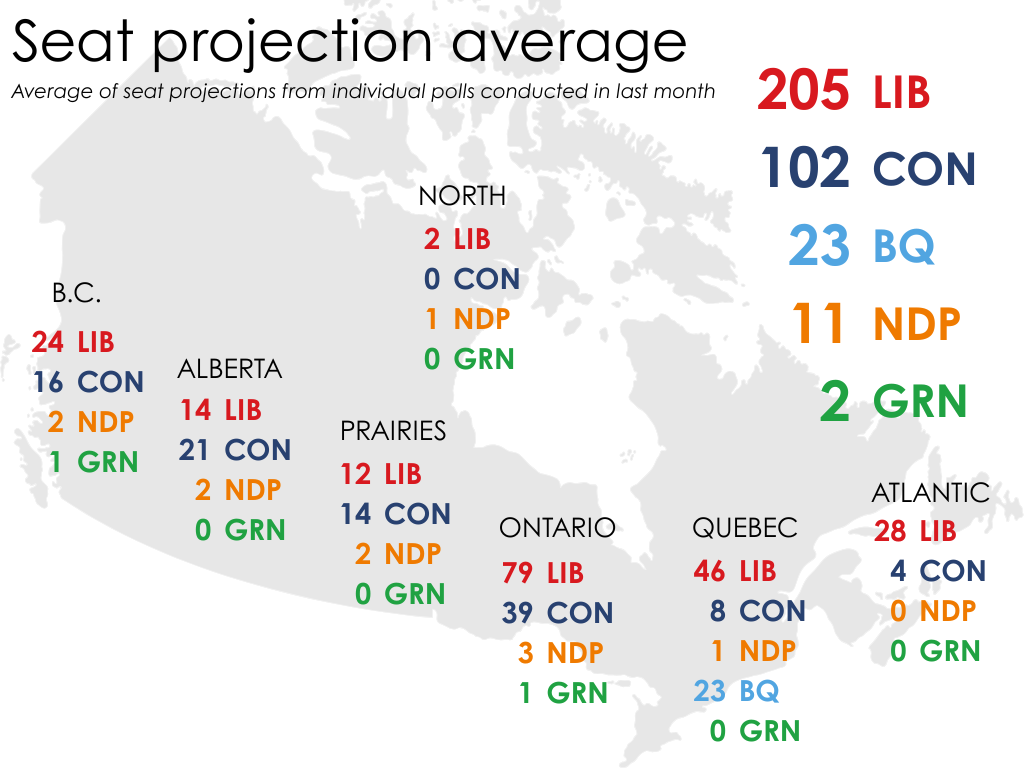
I’m moving closer and closer to the publication of The Writ’s official seat and vote projection model. I’m now at the stage of inputting old data to get some trend lines going back to the 2025 election. Stay tuned!
Quebec’s election looking closer
A new poll from Léger suggests the outcome of Quebec’s provincial election in October is becoming less certain as the gap between the Parti Québécois and the Quebec Liberals shrinks to just one point.
The PQ is effectively tied with the Liberals at 31% to 30%, the latter number representing a four-point gain for the Liberals since Léger’s previous poll conducted at the end of January, before Charles Milliard was acclaimed as the new leader of the PLQ.
There has been a significant shift in voting intentions over the last three months. In early December, the PQ was leading with 39% against just 21% for the Liberals, according to Léger. Since then, the PQ has dropped eight points and the Liberals have picked up nine.
The poll found the Quebec Conservatives in third place with 15%, followed by the governing Coalition Avenir Québec with 13%. This is the first time Léger has put the CAQ in fourth. Québec Solidaire brings up the rear with 9% support.
The PQ holds a 20-point lead over the Liberals among francophones, which is electorally decisive and potentially enough to keep the PQ in majority territory — despite being at just 31% across the province. But the Liberals appear to be making serious inroads in the Montreal region. If that isn’t all concentrated on the island of Montreal (which last week’s Pallas Data poll suggested wasn’t the case), then the PLQ could put some pressure on the PQ in the suburbs surrounding the island. It wouldn’t be enough pressure to put a PQ victory in doubt, but it could raise some questions about the PQ’s ability to secure a majority.
If the party does secure a majority, leader Paul St-Pierre Plamondon has promised to hold a referendum on Quebec independence in his first mandate. But support for sovereignty has hit a new low, with only 26% saying they would vote OUI in a new referendum against 65% who would vote NON. Removing the undecideds shows a 29% to 71% split, which has to rank among the lowest numbers ever recorded for Quebec independence in the last 50 years.
While the sovereignty issue has the potential to weigh down the PQ’s election chances, the ongoing CAQ leadership race looks unlikely to boost the governing party’s fortunes. Earlier polling found that front runner Christine Fréchette made her party far more competitive, but this survey finds that Fréchette would only boost the CAQ to 15%. Still, that’s better than the 8% that Bernard Drainville would get for the CAQ, putting the party dead last.
POLLING NEWS BRIEFS
CANADIAN VIEWS ON IRAN WAR - Nearly half of Canadians oppose the air strikes against Iran that were launched by the United States and Israel this past week, with opposition concentrated among Liberal voters. The poll by the Angus Reid Institute finds support for the strikes at 34% among Canadians, with 49% opposed, while among Liberals opposition rises to 69%. By comparison, support stands at 64% among Conservative voters. This could put the prime minister in an awkward spot, as his government’s stated support of the strikes (with “regret”) appears to put him at odds with his own voter coalition.
CUSMEH? - Polling by Abacus Data suggests the stakes for Mark Carney in the CUSMA negotiations are not as high as one might think when it comes to public opinion. The survey found that 45% of Canadians think the end of CUSMA would be bad for Canada but just 28% think it would be bad for them personally. And, if our trade agreement with the United States and Mexico did come to an end, only 20% would blame Carney for it, compared to 58% who would blame Donald Trump. Of course, if the end of the trade deal has a negative impact on the Canadian economy then, sooner or later, the government will bear the brunt of voters’ discontent. But an end to CUSMA this year, at least according to these numbers, might not shift the dial much when it comes to support for Carney and the Liberals.
TRUMP MAKES CANADIANS MORE OPEN TO INDIA - Canadians have mixed views regarding India and attempts to improve relations between our two countries, according to new polling by the Angus Reid Institute (conducted before Mark Carney’s trip to India concluded). While 53% of Canadians said this was the right time for Carney to visit the country (just 23% said it was too soon or shouldn’t take place), only 33% said that Canada should approach India on friendly terms or as a valued partner and ally. The majority said Canada should approach India cautiously or as a potential threat or enemy. However, while 58% of Canadians took this wary approach to India, that was still lower than the 71% who said Canada should take this approach with the United States. On balance, while Canadians do not seem to be ecstatic about closer ties with India, the climate with the U.S. has made it far more palatable.
BRITISH COLUMBIANS SOUR ON BUDGET - New polling by Pallas Data shows the B.C. NDP narrowly leading over the Conservatives with 42% to 40%, followed by the Greens at 11% and OneBC at 5%. The poll suggests that British Columbians have reacted poorly to the provincial budget, with 52% saying they oppose the direction of the budget, compared to just 33% who support it. The survey also found that Caroline Elliott continues to lead among Conservative voters for the party leadership with 15%, followed by Peter Milobar at 9% and Iain Black, Kerry-Lynne Findlay and Darrell Jones at 7% apiece. Still, 47% of Conservative voters say they are undecided.
12-MONTH ELECTORAL CALENDAR
March 29: Federal NDP leadership
Candidates: Rob Ashton, Tanille Johnston, Avi Lewis, Heather McPherson, Tony McQuail
April 12: Coalition Avenir Québec leadership
Candidates: Bernard Drainville, Christine Fréchette
May 11: Municipal elections in New Brunswick
May 30: British Columbia Conservative leadership
Candidates: Bruce Banman, Harman Bhangu, Iain Black, Caroline Elliott, Kerry-Lynne Findlay, Yuri Fulmer, Warren Hamm, Darrell Jones, Peter Milobar
October 5: Quebec provincial election
October 17: New Brunswick Progressive Conservative leadership
Candidates: Daniel Allain, Don Monahan
October 17: Municipal elections in British Columbia
October 19: Alberta referendum
October 26: Municipal elections in Ontario
October 28: Municipal elections in Manitoba
November 2: Municipal elections in Prince Edward Island
November 9: Municipal elections in Saskatchewan
November 21: Ontario Liberal leadership
November 28: Nova Scotia Liberal leadership
Byelections yet to be scheduled
CA - University–Rosedale (to by called by July)
CA - Scarborough Southwest (to be called by August)
ON - Scarborough Southwest (to be called by August)
CA - Terrebonne (to be called by August)
NS - Chéticamp–Margarees–Pleasant Bay (date TBD)
CA - Beaches–East York (potential resignation pending)
AB - Calgary Shaw (resignation pending)
Party leadership dates yet to be set
Federal Greens (Elizabeth May announced on August 19, 2025)
ON THIS DAY in the #EveryElectionProject
Should Canada become the 45th state?
March 5, 1891
Canadian fears of annexation by the United States are nothing new. Indeed, they were one of the contributing factors that led to Confederation in 1867. Elections won or lost over Canada’s relationship with the United States are also nothing new.
But the issue was perhaps never more front and centre — or more contentious — than in the federal election of 1891.
As the Dominion of Canada approached the 20th century, its prime minister was still a figure who was very much of the 19th. John A. Macdonald was Canada’s first prime minister and by 1891 had served in that role for all but five years since the country’s foundation. Since returning to office after the 1878 election, Macdonald had led his Conservatives (also known as Liberal-Conservatives) to victories in 1882 and 1887, defeating the Liberals under Edward Blake.
But things were beginning to change in Canadian politics. Macdonald was 76 years old and in ill-health as his years of heavy drinking were catching up to him. He knew that he likely only had one more campaign in him and it would be against a new opponent who represented a major shift all on his own.
Wilfrid Laurier had taken over as leader of the Liberals after the 1887 defeat, the first time a French Canadian led a national party. It was an open question whether the age-old divides between English and French, Protestant and Catholic would prevent Laurier from even being given a hearing outside of his home province of Quebec.
The Liberals needed a bold new policy to take to voters to grab their attention. The country’s economy was flagging and the Liberals eyed a potential solution south of the border.
Since 1878, Macdonald had boasted the benefits of his “National Policy”, which essentially amounted to protective tariffs. The National Policy assured that Canada’s manufacturing industry could grow and prosper, safe from competition from the far more dynamic economy of the United States. It also ensured that the agricultural sector wouldn’t be swamped by American goods. For Macdonald, the National Policy was the cause of Canada’s prosperity when things were going well and the solution to its problems when they weren’t.
Ahead of the 1891 election, the Liberals decided to go in another direction: “unrestricted reciprocity”, or free trade with the Americans. Not only would this open up America’s huge market to Canadian products, it would lower costs for farmers who were forced to buy more expensive tools and equipment produced by tariff-protected Canadian manufacturers. It would be the jolt that Canada’s economy needed to get out of the doldrums.
It would also have the benefit of protecting Canada from the increasingly protectionist United States, which had just recently adopted the McKinley Tariffs.
But if the Liberals thought this was the policy that could bring them to power, Macdonald spied an election-winning wedge issue. Reciprocity was not the solution to Canada’s economic malaise. Instead, it was simply the first step toward economic and then full political union with the United States.
The United States was an expansionist power in the 19th century. Through deal-making and war-making, the country had grown from one that was penned in along the eastern seaboard to one that stretched from sea to sea. In 1890, Idaho and Wyoming had been made the 43rd and 44th states.
By the 1890s, fewer American eyes were being cast on the vast Canadian territories as before. But there was still much discussion about annexation and there were advocates on both sides of the border who voiced their support of a continental union. Could Canada become the 45th state?
It was easy to cast the Liberal project as the stepping stone to eventual union — which meant breaking ties with the British Empire. Those old ties with the old country were still strong in large parts of the Dominion, and Macdonald knew how to play on that emotional connection.
“A British subject I was born — a British subject I will die,” he said in a campaign speech in Toronto. “With my utmost effort, with my latest breath, I oppose the veiled treason which attempts by sordid means and mercenary profit to lure our people from their allegiance.”
This “veiled treason” involved allegations Macdonald levied against the Liberals, and in particular Richard Cartwright, the foremost Liberal in Ontario, who he said was conspiring with American annexationists. Macdonald would have none of it.
“During my long public service of nearly half a century,” he went on, “I have been true to my country and its best interests, and I appeal with equal confidence to the men who have trusted me in the past, and to the young hope of the future, with whom rests its destinies for the future, to give me their united and strenuous aid in this, my last effort, for the unity of the Empire and the preservation of our commercial and political freedom.”
There was a lot of nostalgia in Macdonald’s appeal — not only to the old colonial connections to Great Britain but to Macdonald himself. He knew, as did Canadians, that he didn’t have long for this world. He was asking Canadians to stick by him one more time. The Conservatives leaned hard into these appeals to nostalgia, most famously in a campaign poster bearing the slogan “The Old Flag, The Old Policy, The Old Leader.”
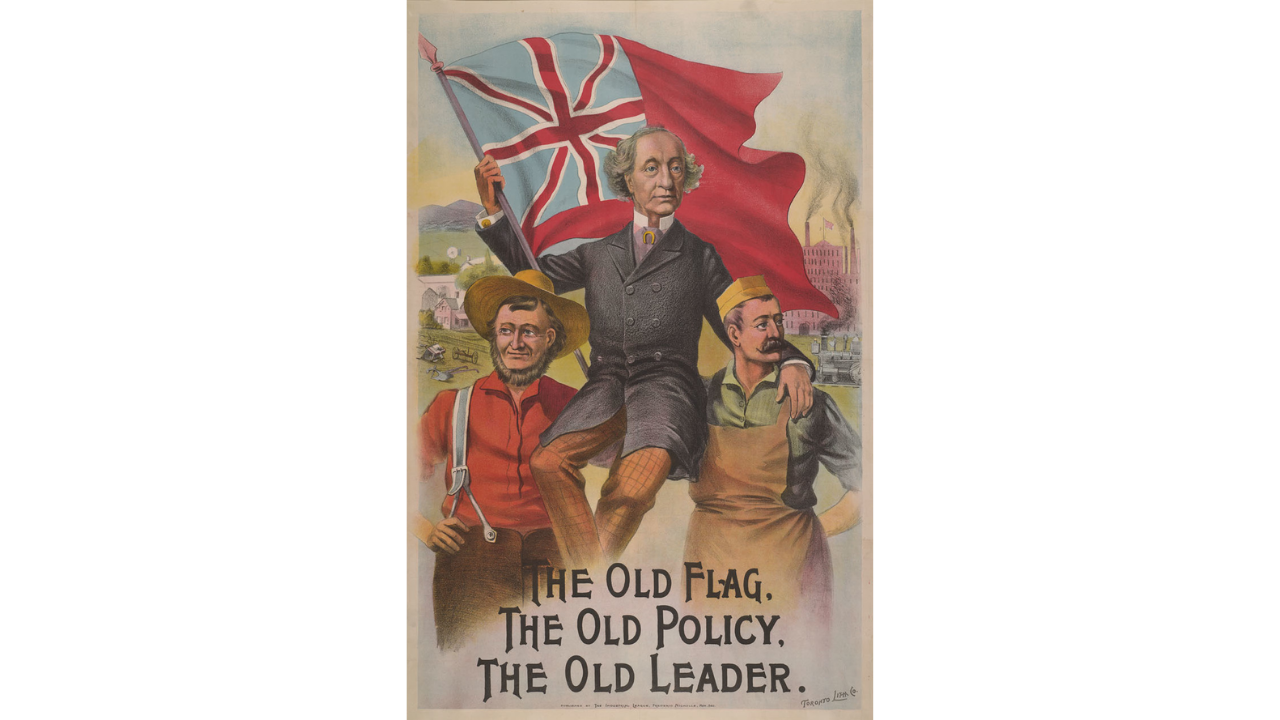
The old flag was, of course, the Union Jack (or the Red Ensign, in this case). The old policy was the National Policy. And the old leader was him. To hammer the poster’s point home, Macdonald was held aloft on the shoulders of a farmer and an industrial worker — in other words, rural and urban male voters (women did not have the franchise) — as he flew the flag one last time.
Macdonald was an old warhorse of a campaigner. This was his seventh campaign as national leader of the party, in addition to his pre-Confederation campaigns. Despite his advanced age (and the cold February winter), Macdonald was touring southern Ontario holding two rallies per day.
Wilfrid Laurier, on the other hand, kept quiet in the first week of the campaign, holed up in his headquarters in Montreal. He let Richard Cartwright in Ontario and Premier Honoré Mercier in Quebec lead the charge in the early days.
When he did finally venture out, he met Macdonald’s charges of disloyalty in a speech in Quebec City, where he was running as a candidate. But he didn’t have the tubthumping, populist style of his wily old opponent.
“No, gentlemen; as of yore we are still true and loyal to our Sovereign Lady the Queen,” he said. “But if our interests were in opposition to those of England, we would stick to ours by all means. We are Canadians and we will watch Canada’s welfare before all.”
This was the contrast between the two parties and the two men. Macdonald’s view of Canadian success was an economy protected from American competition and which maintained its close ties with the British Empire. Laurier’s view was of a Canada more self-confident, ready to take on competition with the Americans and willing to chart its own course, independent of Great Britain (and the United States). It was the old vs. the new.
At 49 years old at the time of the election, Laurier was not exactly a very young man. But Macdonald was more than 25 years his senior. And both men took ill with the pressures of the campaign. But while Laurier would recover, Macdonald never would.
Before long, Macdonald had to reduce his schedule to one rally per day. But in the final stretch of the campaign, he was induced to hold two rallies one day in eastern Ontario, riding in an open carriage in the late February air on both occasions. His strength collapsed and his secretary, Joseph Pope, had to cancel all further events for the rest of the campaign. Macdonald wouldn’t hit the hustings again, heading to bed on election night without knowing whether had had won or not.
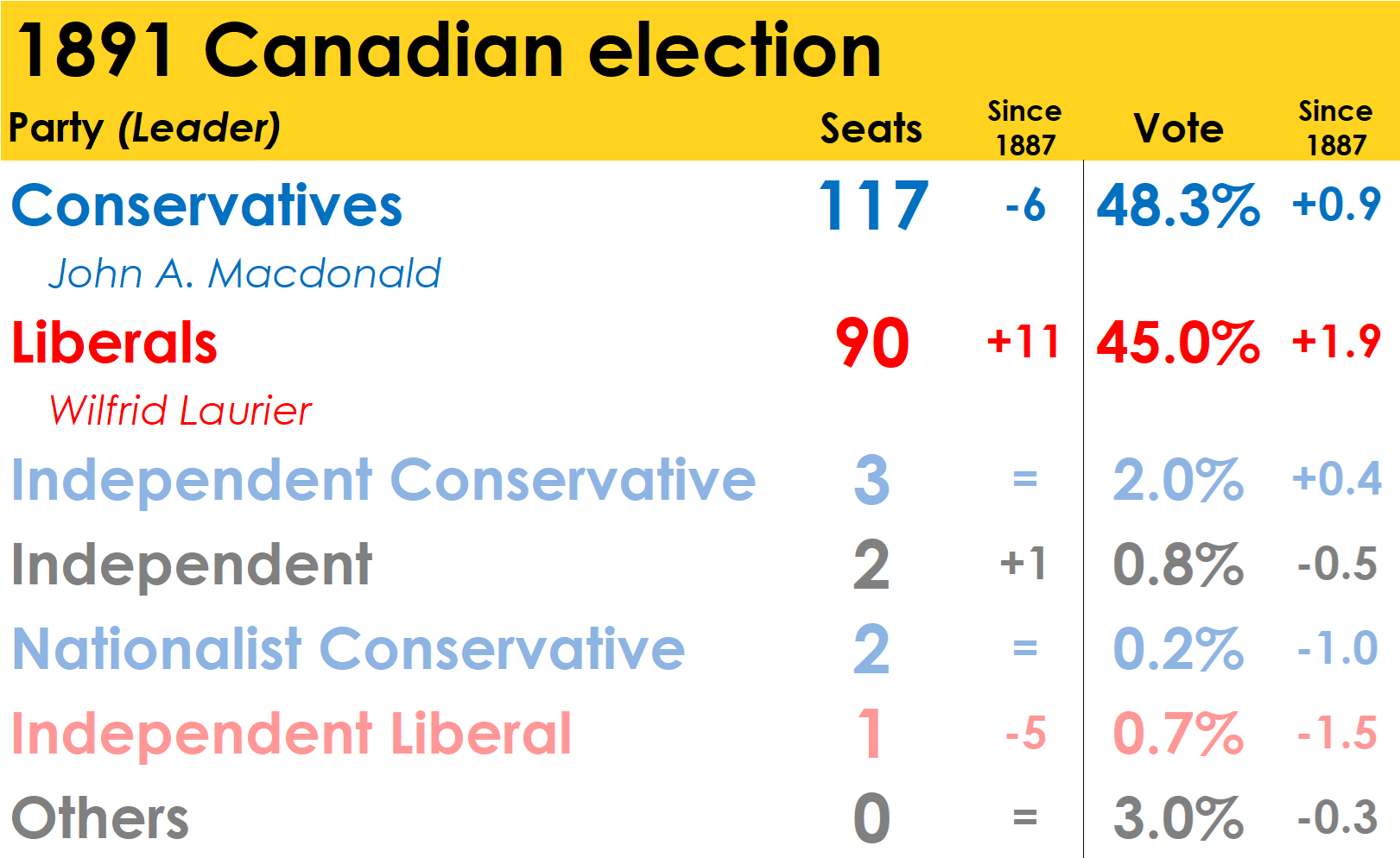
But his appeal to Canadians’ loyalty to the old connection prevailed — if only just. The Conservatives won 117 seats and 48% of the vote, enough to secure another majority in the House of Commons. The Conservatives swept all of B.C.’s six seats and the four seats in the Northwest Territories (which then included what is now Alberta and Saskatchewan). They dropped seats in Ontario and Quebec, but gained six in the Maritimes.
Overall, however, the Conservatives had lost six seats from the 1887 election and their majority had been reduced. The Liberals took 45% of the vote, putting them just behind the Conservatives, and won 33 of Quebec’s 65 seats. While it wasn’t much of a surprise that Quebecers had embraced a native son, the Liberals’ breakthrough in Ontario with a gain of seven seats, putting them nearly even with the Conservatives, was significant — and a sign that English-speaking Protestants could indeed vote for a French Canadian Catholic. It bode well for Laurier’s future.
But the Conservatives paid a steep price for one more election victory. Pope believed that Macdonald never fully recovered from the “chill” he suffered that cold day on the campaign trail. In May, Macdonald suffered a series of strokes. He passed away on June 6, 1891, nearly three months to the day after his last election win.
The Conservatives wouldn’t fully recover from the loss of Macdonald. After cycling through four successors, the Conservatives would finally go down to defeat in 1896 when Laurier, who had dropped his policy of unrestricted reciprocity, had learned not to test Canadians’ appetite for closer ties with the United States.
MILESTONE WATCH
On Monday, Mark Carney marks a year since he won the 2025 Liberal leadership contest with 86% of the points on offer, crushing his rivals for the job. Since becoming leader of the Liberals a year ago, Carney has led the party to its fourth consecutive electoral victory and appears poised to secure the majority he failed to win last April, either through byelections and floor-crossers or, just maybe, another election.
Then, on Tuesday, Doug Ford will mark eight years as leader of the Ontario Progressive Conservatives. Ford defeated Christine Elliott for the leadership of the Ontario PCs in 2018 thanks to the vagaries of the points system — he won neither the most votes nor the most ridings. Despite that inauspicious start, Ford has been one of the more successful leaders the PCs have ever had. The only other party leaders to win three consecutive majority governments were James Whitney, Howard Ferguson and Leslie Frost.
Do you think we’ll see any effects of Iran in Carney’s polling over the next few weeks? Avi Lewis has been bringing the attack to Carney on social media & I wonder if the NDP could see a corresponding boost.