


Welcome to the Weekly Writ, a round-up of the latest federal and provincial polls, election news and political history that lands in your inbox every Thursday morning.
Pierre Poilievre is slated to learn the result of his leadership review at the Conservative convention in Calgary tomorrow night. Technically, he only needs 50%+1 to stay on.
In reality, he has to do much better than that.
While there are no concrete rules when it comes to what leadership score is good enough (beyond the pass-fail), history suggests there are some thresholds leaders must cross in order to keep their leadership secure.
And 50% is not nearly enough. Alberta premier Jason Kenney resigned the leadership of the United Conservative Party in 2022 after receiving the endorsement of only 51% of members. Bonnie Crombie, who got 57% in her review last year, resigned the leadership of the Ontario Liberals shortly thereafter.
The next threshold is where things get murky. Leaders who score between 60% and 80% tend to have to keep an eye over their shoulder. Last year, Marit Stiles scored 68% in her review and appears to be safe in her leadership of the Ontario New Democrats. John Rustad, who managed 71% in his leadership review, was unable to silence his critics or keep the turmoil within his party from boiling over, and was forced out.
Joe Clark, then leader of the federal Progressive Conservatives, famously called a leadership race (in which he ran again and lost) after securing only 67% support in 1983. Bernard Landry resigned as leader of the Parti Québécois (a decision he later regretted) when he got just 76% in 2005. Alberta premiers Ed Stelmach and Alison Redford initially stayed on as leader with 77% in their respective leadership reviews but that result was not good enough to paper over their weaknesses and they were both out before the next elections.
Under 80% can be a problem — even if it is a healthy majority in any other context it usually signals that there is serious discontent within a party that, sooner or later, will catch up to the leader. Over 80%, on the other hand, is usually good enough.
It was good enough for Stephen Harper in 2005. At the Conservative Party’s first convention following its defeat in the 2004 federal election, Harper secured 84% in his leadership review. It was enough for Harper, who lost his first election as leader, to stay on and fight another day. He’d be prime minister within a year.
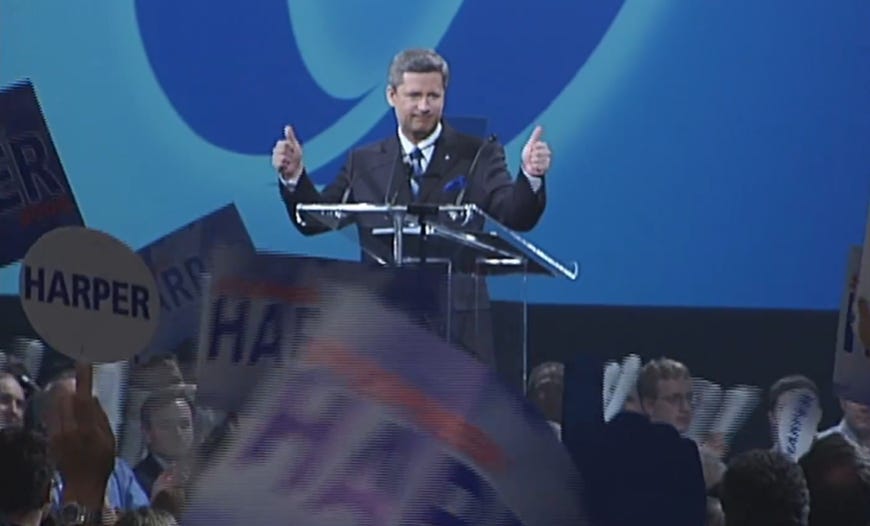
This was the last time a formal leadership review has been held by the Conservatives. Both Andrew Scheer and Erin O’Toole were out as leaders before they faced a vote from members, while 2005 was the last convention during the Harper era in which he wasn’t prime minister. That 84% score, even if it was 21 years ago, appears to be the only historical benchmark for Poilievre to meet tomorrow.
We don’t have a lot of other precedents to work with. The Liberals haven’t bothered with a leadership review in nearly 40 years. The New Democrats hold them far more frequently — Jack Layton managed between 89% and 98% in his leadership reviews, while Tom Mulcair saw his 92% in 2013 cut nearly in half to 48% in 2016. Jagmeet Singh’s score kept dropping, from 91% in 2018 to 87% in 2021 and finally 81% in 2023.
Though 2025 was a rough year for Rustad, Crombie and Stiles, other provincial leaders did far better. Scott Moe, David Eby, Naheed Nenshi and Carla Beck all scored between 80% and 90%.
So, something in the 80s would seem to be the minimum target for Poilievre. A score above 90% would allay any doubts about his control over the party — those kinds of results are usually reserved for leaders who won an election, are poised to win an upcoming election or are just coming off a historic breakthrough. Pierre Poilievre is not any of those things at the moment, so a 90%+ result would be a flex.
We don’t have any strong indications what the number will be. No polling of party members has been published and the best we have are party insiders saying Poilievre should have no trouble passing the review (though, notably, none are suggesting he should get 90%+).
Polling of the general public by Abacus Data finds that 76% of the Conservative base (Canadians who would not consider voting for another party) would vote to keep Poilievre in his job, while 14% would vote to replace him. If we exclude the 10% of undecideds, that puts Poilievre’s support at 84% among the Conservative base — exactly matching Harper’s score in 2005.
That’s the bar for Poilievre. It was a bar that was good enough for Stephen Harper after his first electoral defeat and it’s the bar that has been set in polling of dedicated Conservatives. If he clears it, he should be fine. At least for the time being. Prolonged struggles in the polls could cause problems down the line.
But if he doesn’t clear or at least approach the bar of 84%, 2026 could prove to be a tough year for Pierre Poilievre — even if he survives the weekend.
Now, to what is in this week’s instalment of the Weekly Writ:
News on how the Coalition Avenir Québec leadership race is shaping up.
Polls show a big bump for Mark Carney and a little one for the Liberals — enough to put them back in majority territory. Plus, a look at the Conservative voter base and new numbers out of Alberta and Ontario.
#EveryElectionProject: The 2001 Saskatchewan NDP leadership race.
Upcoming milestones for Scott Moe and Marit Stiles.
NEWS AND ANALYSIS
CAQ leadership contest becomes B-Team duel
The Coalition Avenir Québec has settled on the rules for its leadership contest. The second-ever leader of the CAQ, and the next premier of Quebec, will be named on April 12.