


Welcome to the Weekly Writ, a round-up of the latest federal and provincial polls, election news and political history that lands in your inbox every Thursday morning.
Last week’s announcement of an agreement between the Alberta and federal governments that could see a new west coast pipeline built certainly captured people’s attentions and could have political, economic and environmental repercussions for years (and potentially decades) to come.
But the early signals suggest that it hasn’t had much impact on public opinion — yet.
From an electoral perspective, the Liberals would be taking a real gamble if the memorandum of understanding (MOU) boiled down to a choice between seats in British Columbia and seats in Alberta. The Liberals won 20 seats in B.C. in the April election but just two in Alberta. Not only that, but the Liberals have far more to lose in B.C. than they have to gain in Alberta.
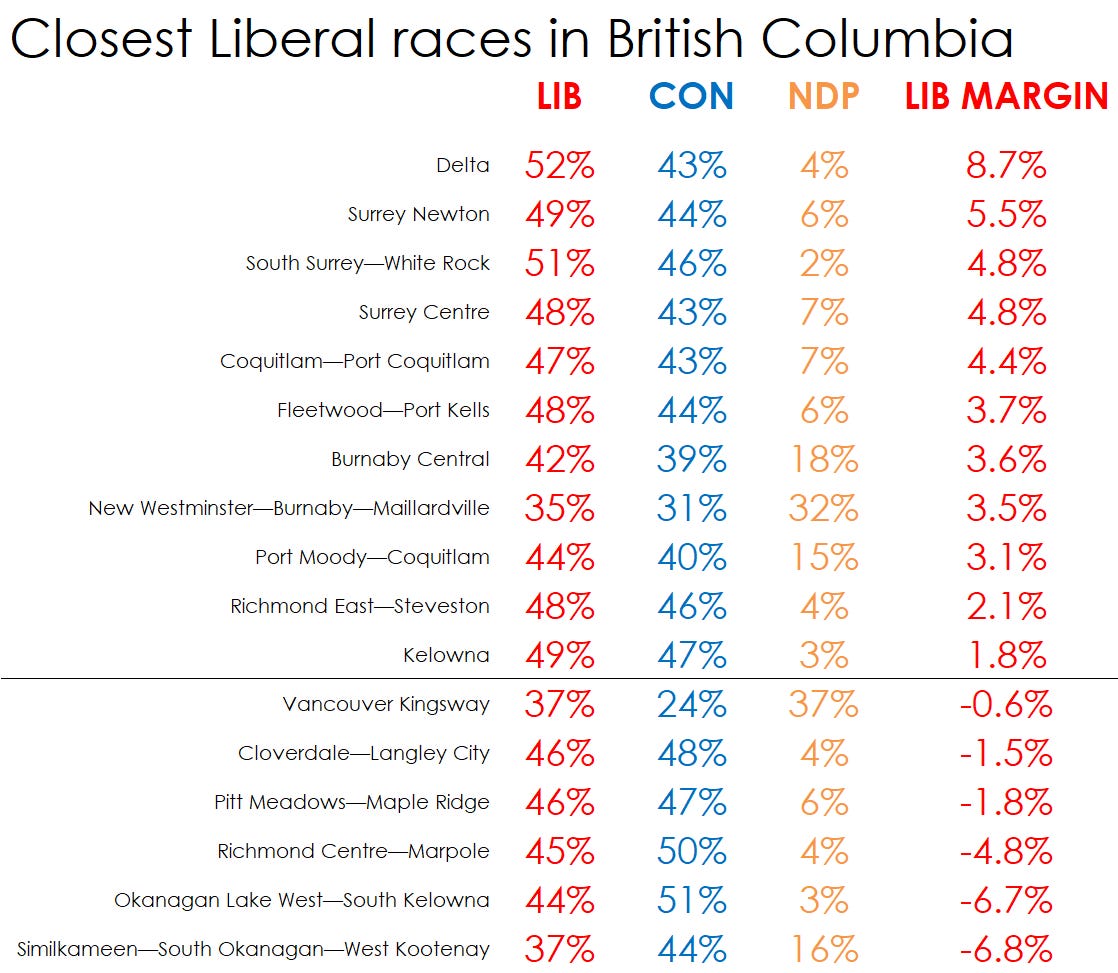
Of the Liberals’ 20 seats in B.C., 11 of them were won by a margin of nine points or less. A small loss of support for the Liberals in British Columbia could lose them many of these seats — largely to the Conservatives.
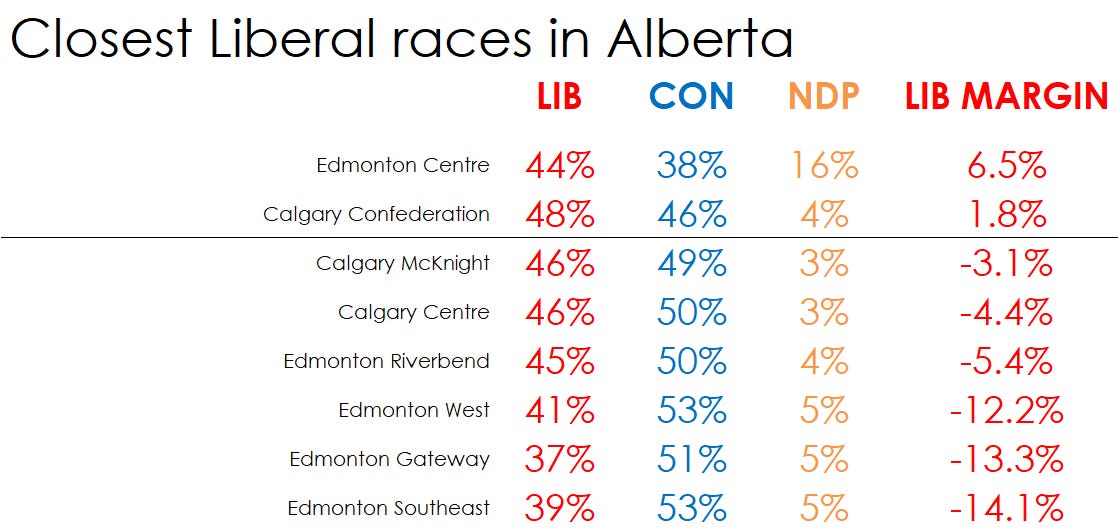
By comparison, the upside for the Liberals in Alberta is very low. An uptick in support could solidify their hold on Calgary Confederation, but they would need to see a big swing toward them to have a shot at winning anything more than the three seats they lost by a few percentage points.
It goes without saying that the Liberals should be able to make these calculations themselves. It’s unlikely that the party seriously believes that they could entirely make up for losses in British Columbia with gains in Alberta.
Instead, the Liberals have probably concluded that either the pipeline issue won’t lose them much support in B.C. or that the benefits they could gain in the rest of the country outweigh the risks.
New polls conducted by the Angus Reid Institute (pre-MOU and post-MOU) and Abacus Data suggest that could indeed be the case.
Both surveys show that a majority of Canadians, including people who live in British Columbia, support the idea of building a pipeline from Alberta through northern B.C. to the west coast. It was 60% support to 25% opposition nationally according to the ARI, while Abacus puts it at 55% for to 18% against. In B.C., support was 53% in both polls, with opposition sitting between 30% and 37%.
The ARI survey included a more detailed regional breakdown, showing that opposition was higher in Metro Vancouver and especially on Vancouver Island and the North Coast — the regions that would be most impacted by any potential spill. But, nevertheless, a plurality of respondents in both regions were supportive.
The risk for the Liberals is not where these voters live but who they are. The ARI found that a majority of British Columbians who voted for the Liberals are opposed to a pipeline (32% support to 54% opposition). That stands in contrast to the 49% support, 35% opposition among their voters across the country. This suggests that Liberals in B.C. view the pipeline issue differently than Liberals in the rest of the country.
But there’s no clear evidence that this difference of opinion has impacted Liberal support (not every issue is a ballot box issue). The ARI found that Mark Carney’s personal ratings in B.C. (52% approval, 41% disapproval) were no different after the MOU than they were in early November. Instead, the ARI has found improvement in Carney’s ratings in Alberta and Saskatchewan.
And while the ARI found Liberal support sliding five points in British Columbia, the Conservatives were the net beneficiaries (primarily due to the increase in undecideds). Compared to a pre-MOU survey, Abacus found the Conservatives holding steady and the Liberals up one point in British Columbia. Suffice to say, there is no consensus here — especially considering that all of these shifts, including the Liberals’ drop in B.C. in the ARI survey, would be within the margin of error of a probabilistic sample.
But what about the rest of the country? The resignation of Steven Guilbeault from cabinet was big news in Quebec, where the former environment (and, until recently, culture and identity) minister is well-known. There has been speculation that this alone could cause a drop in support for the Liberals.
The ARI did find a seven-point slide in Mark Carney’s net approval rating in Quebec, though this appears to have largely been due to a drop in support among Bloc voters. That probably has little electoral implications. Indeed, Abacus gave the Liberals the same nine-point lead over the Bloc in Quebec post-MOU as they had recorded pre-MOU.
Abacus also found that Guilbeault is far from a superstar in Quebec. While 25% of Quebecers have a positive view of Guilbeault (far higher than his single-digit scores in B.C. and Alberta), another 19% have a negative view. Those numbers are far worse than Carney’s own 48% to 23% split in Quebec. Carney could lose a little shine in the province as a result of Guilbeault’s departure, but his former minister has not gone scorched-earth on Carney, saying on Tout le monde en parle on Sunday night that he still has his vote.
While there is risk for the Liberals in B.C. (and perhaps in Quebec), there is also some potential for gains elsewhere. Abacus found that 54% of Canadians agreed with the statement that the deal represents a “worthwhile compromise that could bring major economic gains for Canada” while only 24% agreed that instead it was a “betrayal of the progress Canada has made on environmental policy and contradicts Mark Carney’s own previous positions on energy and the environment”. In Ontario, the split was 54% to 20%. Generally speaking, the Liberals are fishing for votes in the much larger pool of supporters of the pipeline project, trade diversification and compromise with Alberta.
Much will depend on where things go from here. The building of a pipeline is not in and of itself a controversial or risky proposition — Canadians are in favour of it. The Liberals have some reason to believe they can mitigate their risks in B.C. while adding to Mark Carney’s reputation in the rest of the country as a sound economic manager. But if things do not unfold smoothly, the Liberals could not only lose the support in B.C. that helped them win an election, but they could also see Carney’s image tarnished by a very public failure.
Bold moves can pay off big time. They can also blow up in one’s face. For now, we’ll have to wait and see what happens next.
Here’s what’s in this week’s instalment of the Weekly Writ:
News on an upcoming byelection in Prince Edward Island, a successful petition in Alberta, a leadership debate for the NDP, a new electoral map for Quebec and more trouble for John Rustad.
Polls give Mark Carney’s federal Liberals a narrow lead as 2025 comes to a close, while new numbers show that the provincial Liberals’ problems in Quebec have had an impact on Pablo Rodriguez and his party’s support. Plus, a newly-released survey shows the value of choosing your words carefully.
#EveryElectionProject: The Alberta Social Credit League’s first (and most colourful) leadership race in 1968.
Upcoming milestone for Pierre Poilievre.
The first Weekly Writ of the month is free for all subscribers. If you haven’t already but would like to get full access to the Weekly Writ every Thursday, please upgrade your subscription — and thanks for your support!
NEWS AND ANALYSIS
PEI byelection will test PCs, Liberals
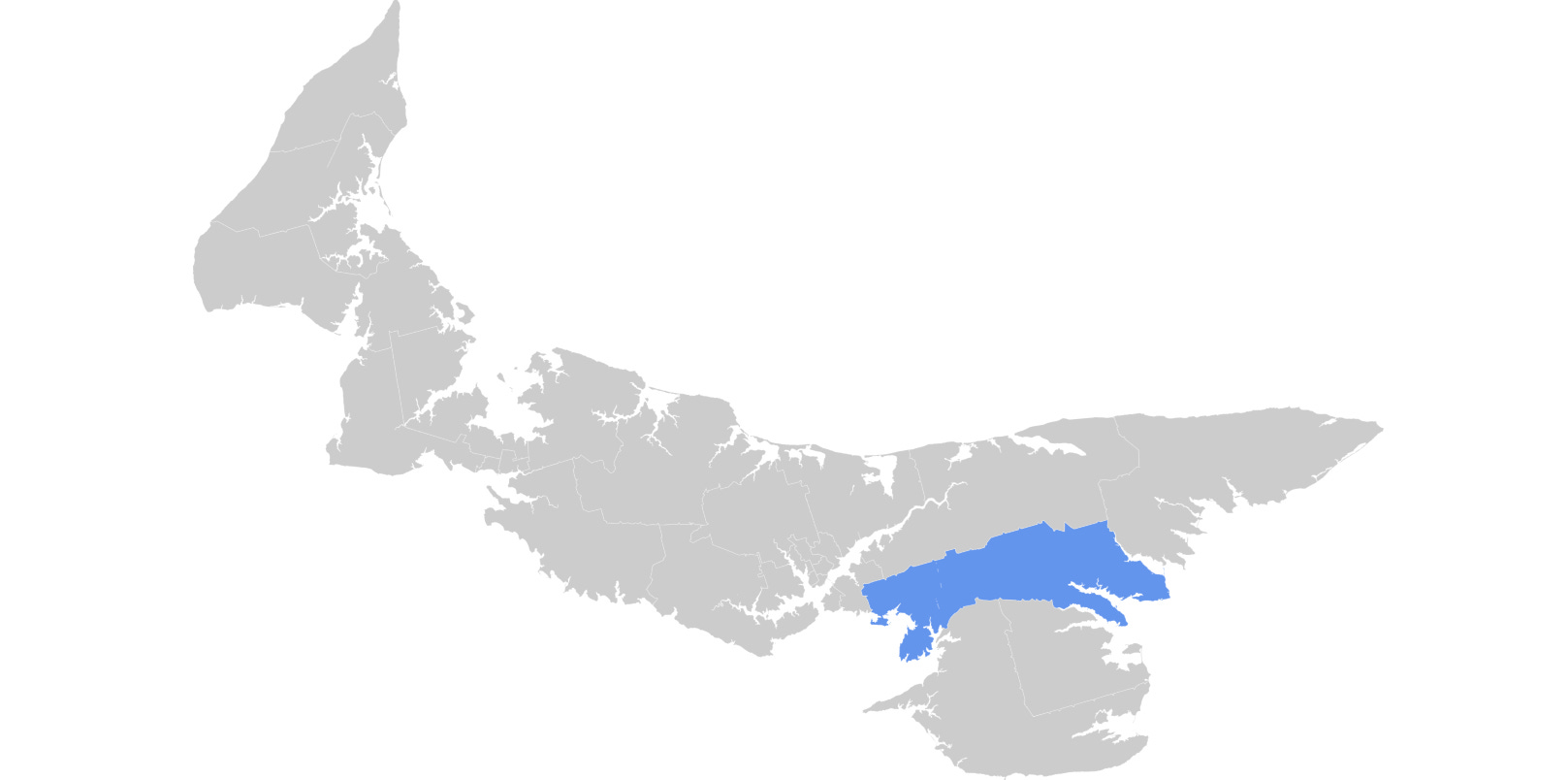
A provincial byelection worth watching is taking place in Prince Edward Island on Monday, as the governing Progressive Conservatives aim to hold the district of Georgetown–Pownal.
Under normal circumstances, the outcome of this byelection would not be in any doubt. Steven Myers won it for the PCs with 69.8% of the vote in the 2023 provincial election. The Greens and Liberals finished well back with 12.5% and 12.1%, respectively.
But ridings with small populations can swing pretty wildly — as we’ve seen in PEI in the last two years.
In 2024, there was a total swing of 36 points between the PCs and Greens in Borden–Kinkora, enough to flip the district from blue to green. Earlier this year there was a 30-point swing between the PCs and Liberals in Brackley–Hunter River and a massive 58-point swing between the two parties in Charlottetown–Hillsborough Park, which the Liberals were able to flip.
That swing in Charlottetown–Hillsborough Park is notable because the PCs beat the Liberals by about 58 points in Georgetown–Pownal in the 2023 provincial election. If the Liberals can pull off that huge swing again, they might be able to take the seat.
That’s what Robert Mitchell is hoping. He won the Liberal leadership earlier this year and is standing as the party’s candidate in Georgetown–Pownal. It’ll be a very tall order for Mitchell to do the same thing here as his party did in Charlottetown–Hillsborough Park, as the district is not nearly as Liberal-friendly. The Liberals had won what is now Charlottetown–Hillsborough Park as recently as the 2015 election, but they haven’t won the district containing Georgetown since 1993.
Regardless of who wins, the byelection will be a useful for barometer for where things stand in PEI. We haven’t seen a poll out of the province since 2024, though numbers from a Narrative Research survey conducted in August that were referenced by the PEI Liberals suggested that the PCs and Liberals were in a virtual tie. If true, this would mark the first survey to show the Liberals in a competitive race with the PCs since before the 2019 election.
ELECTION NEWS BRIEFS
RUSTAD OUSTED? - After a majority of B.C. Conservative caucus members signed a letter calling for John Rustad’s resignation as leader, the board of directors of the party has removed Rustad (claiming he is “professionally incapacitated”, as incapacitation is one reason the party’s constitution would allow the board to remove the leader) and has endorsed MLA Trevor Halford as his interim replacement. As of writing, it was not clear whether Rustad was actually leader or not, as he and some of his caucus have refused to recognize the board’s decision, while Halford admitted to reporters he wasn’t sure if he was actually going to lead the opposition in the legislature. It’s going well.
NDP LEADERSHIP DEBATE - The New Democrats held their first official leadership debate last week in Montreal, as Rob Ashton, Avi Lewis, Heather McPherson, Tony McQuail and Tanille Johnston faced off in a debate that was supposed to be conducted mostly in French. Only Lewis and McPherson were able to go beyond laboriously reading prepared statements in the language, and both were the only ones who were able to take and respond to questions in French in the post-debate scrums. Of the two, Lewis was more comfortable in speaking off the cuff but if he wins the contest he would still be the weakest of the four leaders at the next election’s French-language leaders debate (yes, behind Mark Carney). While the ability of the contestants to speak French is unlikely to be the most important factor for a party membership that is overwhelmingly from outside of Quebec, the debate served as a demonstration of how far the NDP has drifted away from the Orange Wave of 2011. You can watch the debate (and the post-debate scrums) on CPAC.
ALBERTA REFERENDUM PETITION - A petition organized by the “Alberta Forever Canada” group led by former PC MLA Thomas Lukaszuk, successfully got enough signatures to be passed along to the Speaker of the Legislative Assembly. The petition calls for a referendum with the question “Do you agree that Alberta should remain in Canada?” Next steps would see it sent to a committee at the legislature, which could then recommend that a referendum be held during or before the next provincial election.
NEW QUEBEC MAP - A court has ruled that the National Assembly’s decision to put off a re-drawing of Quebec’s electoral map until after the 2026 provincial election is unconstitutional. The work of the commission tasked with designing the new map is starting again and should be implemented in time for next year’s vote. Controversy erupted when the commission proposed removing a seat from the Gaspésie region (as well as from the island of Montreal) and adding seats to faster-growing parts of the province. In its ruling, the court suggested that the National Assembly could act by simply giving the Gaspésie (and any other region with unique representation requirements) the same sort of special status enjoyed by the Magdalen Islands, which are represented by a single MNA despite their very small population.
POLLING HIGHLIGHTS
Consensus close race, but Liberal lead
A series of new polls show little disagreement on the state of the federal race, with the Liberals and Conservatives within a few points of one another and, on average, the Liberals narrowly ahead.
In addition to the Abacus and Angus Reid Institute polls mentioned above, there have also been new numbers from Liaison Strategies and Nanos Research.
All four of these polls put the Liberals between 40% and 42% support, with the Conservatives sitting between 36% and 41%. The New Democrats trail with between 7% and 12%. On average, the Liberals are at 41%, followed by the Conservatives at 38% and the NDP at 9%.
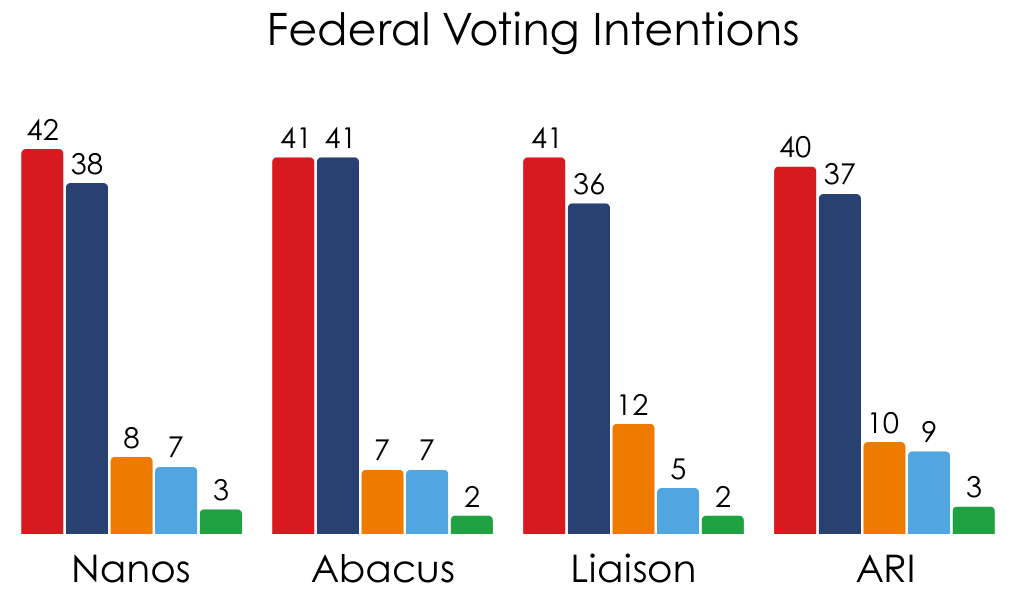
Despite it being a rather momentous month — a floor-crossing, a budget, the MOU with Alberta and a cabinet resignation — there has been no movement in public opinion since early November. Compared to when these four pollsters were all in the field just around the budget, the Liberals and Conservatives have shown no change (on average), with the NDP down a little less than a point. Opinions are pretty solidly set.
Regionally, the Liberals have a lead of roughly seven points in Ontario, 10 in Quebec (over the Bloc) and 12 in Atlantic Canada. This would suggest a somewhat closer race in Quebec and Atlantic Canada, while the Liberals have marginally improved their position in Ontario.
The Conservatives are ahead by an average of three points in B.C. (which they lost by 0.6 points in the last election) and have their usual big leads in Alberta and the Prairies, though the margins in Alberta are smaller than they were in April.
That’s the only reason the Liberals are up in the seat projection average from their current standings — their seat haul is nearly identical everywhere else. The Liberals are projected to be on the threshold of a majority with 172, while the Conservatives are down to 131, the Bloc up slightly to 25 and the NDP narrowly in recognized party status with 13.
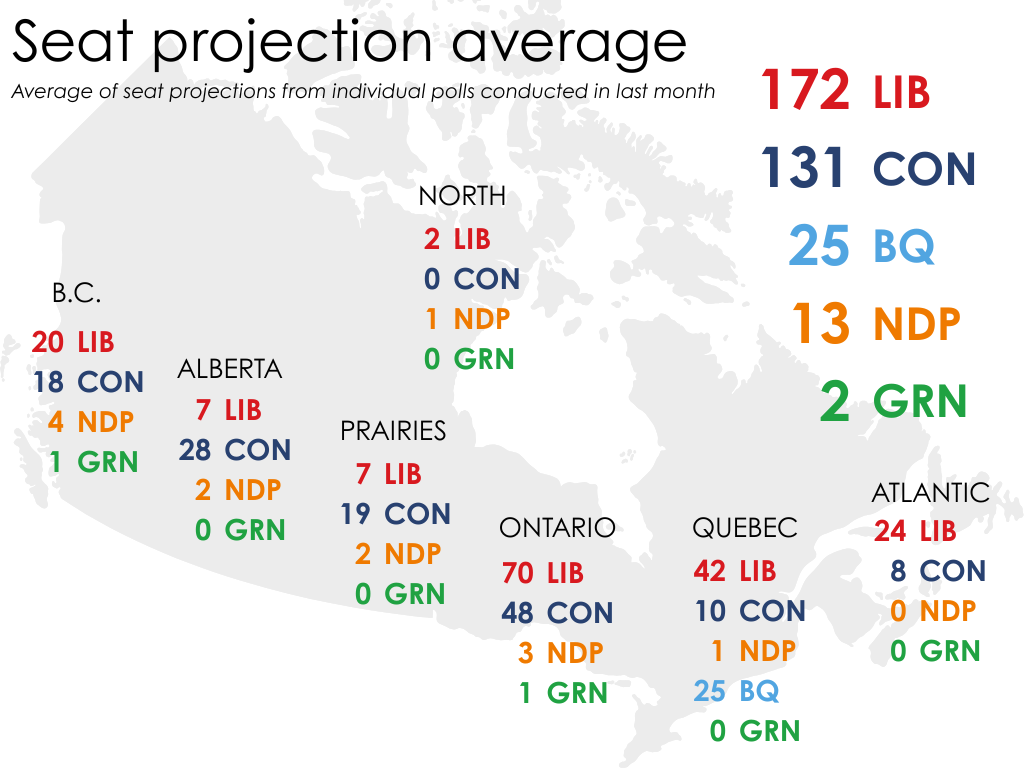
A lot of seats are projected to be decided by less than a percentage point. The Liberals are leading in five of those tight races and are in second place in four of them, giving them a near-literal toss-up range of 167 to 176 seats. Similarly, the NDP is just as close to winning 11 seats, and falling short of recognized party status, as it would be to increasing its caucus to 15 seats.
What a difference a year makes, though. On December 2, 2024, my model was awarding 218 seats to the Conservatives, with the Liberals at 60, the Bloc at 39 and the NDP at 24. It’s been an eternity since then.
POLLING NEWS BRIEFS
QUEBEC LIBERALS SLIDE - Polling by Léger suggests the latest turmoil within the Quebec Liberal Party has severely sapped its strength. The PLQ has slid six points over the last few weeks down to just 21% as the Parti Québécois moves further ahead. The PQ leads with 39%, a gain of seven points. The CAQ, Conservatives and Québec Solidaire trail with 18%, 13% and 8%, respectively. The PQ has 48% support among francophones as the Liberals have fallen to fourth place with just 10%, pointing to a huge majority for the PQ if these numbers were replicated at the ballot box. The poll puts support for sovereignty at 33%, or 37% after the removal of undecideds.
WATCH YOUR LANGUAGE - A fascinating survey by PoliSci shows the power of messaging (and poll question wording). Conducted in August, PoliSci asked respondents different versions of a series of questions. Among other things, it found a 19-point difference in support for “increasing the carbon tax on businesses” vs. “increasing the price on pollution on businesses” and a 12-point difference between support for “foreign investment” vs. “international investment”. Mentioning Trudeau instead of “the government” caused a 14-point drop in agreement that Trudeau’s/the government’s “affordable childcare program has been good for Canada”, while telling respondents that Donald Trump wants to make daylight savings time permanent caused a six-point slide in support for the idea.
12-MONTH ELECTORAL CALENDAR
December 8: PEI byelection in Georgetown–Pownal
March 29: Federal NDP leadership
Candidates: Rob Ashton, Tanille Johnston, Avi Lewis, Heather McPherson, Tony McQuail
May 11: Municipal elections in New Brunswick
October 5: Quebec provincial election
October 17: New Brunswick Progressive Conservative leadership
Candidates: Daniel Allain
October 17: Municipal elections in British Columbia
October 26: Municipal elections in Ontario
October 28: Municipal elections in Manitoba
November 2: Municipal elections in Prince Edward Island
November 9: Municipal elections in Saskatchewan
November 28: Nova Scotia Liberal leadership
Byelections yet to be scheduled
QC - Chicoutimi (to be called by March)
CA - Edmonton Riverbend (resignation pending)
Party leadership dates yet to be set
P.E.I. PCs (Dennis King resigned on February 20, 2025)
Federal Greens (Elizabeth May announced on August 19, 2025)
Ontario Liberals (Bonnie Crombie announced on September 14, 2025)
B.C. Conservatives (John Rustad forced out on December 3, 2026)
(ALMOST) ON THIS DAY in the #EveryElectionProject
Social Credit tries to turn a new leaf
December 6, 1968
The Alberta Social Credit League, which presided over one of Canada’s longest-tenured governments, was a bit of an oddity.
It was borne out of the desperation of the Great Depression, when an evangelical radio preacher named William Aberhart adopted an oddball monetary theory as his political platform and led Social Credit to an unexpected victory in the 1935 provincial election.
Aberhart’s time in office was cut short by death and Social Credit’s theories weren’t implemented — they tended to be unconstitutional — but his replacement, Ernest Manning, was able to adapt the Social Credit platform to Alberta’s political climate. During the Socreds’ time in office, Alberta went from a struggling agrarian province to a booming oil-fueled modern economy. The only problem was that Social Credit wasn’t modernizing as quickly.
Manning’s electoral success is unparalleled in Alberta. He led Social Credit to seven consecutive majority governments. By 1968, he had been premier for 25 years. He won another solid majority in the 1967 provincial election, but the party’s 45% vote share was the lowest ever for Manning. The premier recognized that something needed to change to block the rise of the Progressive Conservatives, now under the dynamic leadership of Peter Lougheed.
A new leader would have to take Social Credit forward. So, at the end of September, Manning announced he would resign as premier and leader of the party. His replacement would be named at a convention held between December 4 and 6, 1968.
The field of candidates was led by Harry Strom, the municipal affairs (and former agriculture) minister. An MLA from southern Alberta since 1955, Strom was one of the few cabinet minister who Manning told first about his retirement plans. Anders Aalborg, one of the heirs-apparent to Manning and one of the other ministers let in on the plan, declined to run. Strom was reluctant to throw his hat into the ring, but was convinced to put his name forward.
Strom’s two main opponents were fellow cabinet ministers. They were the “crisply efficient” Gordon Taylor, the longtime minister of highways and an MLA since 1940, and Raymond Reierson, the education and labour minister and an MLA from northern Alberta first elected in 1952.
Three other candidates also stepped up. There was the attorney general, Edgar Gerhart, also first elected in 1952 but only recently elevated to cabinet. Walter Buck, a dentist and rookie MLA, put his name forward, as did Alfred Hooke, the lands and forest minister and one of the original Social Credit MLAs first elected in 1935.
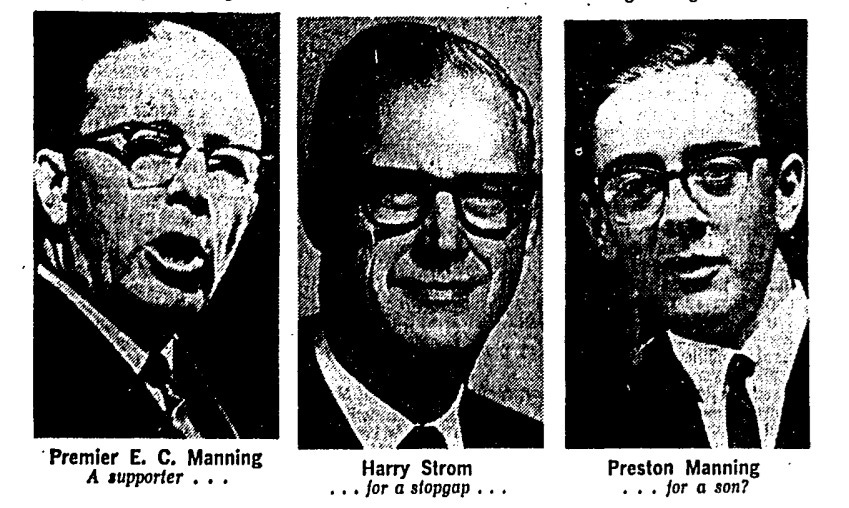
Despite the wide field, Strom was recognized as the clear front runner. He put forward a detailed policy platform and had the backing of a majority of caucus, several cabinet ministers and a circle of young reformers that included Preston Manning, the son of the premier.
The son had been suggested as a potential replacement for the father, but Ernest Manning thought the 26-year-old Preston wasn’t yet ready for the big job. The involvement of Preston in the Strom campaign and the rumoured support that Ernest Manning and the establishment of the party was giving Strom rankled with the other contestants.
While there was little broader enthusiasm for the leadership contest outside of party circles, the three-day convention at the Jubilee Auditorium was a raucous affair for the 1,700 voting delegates — and something quite unusual for a party that had never held a leadership race before (Manning was chosen by caucus in 1943).
According to The Globe and Mail, on the first day of the convention a group of “teen-age girls were in the basement of the auditorium rehearsing a ditty entitled ‘It’s Gerhart All the Way’ to the tune of ‘Jingle Bells’”, in preparation of the rallies and speeches scheduled for the second day. John Barr, writing in Alberta Premiers of the 20th Century, paints a vivid picture of what that second day on the convention floor was like:
“A giant red and white Ray Reierson billboard had been parked next to the front door, and in the midst of the rotunda a rock band was thumping it out for Ed Gerhart. Incredulous convention delegates — small-town hardware merchants with steel-rimmed glasses, schoolmarms from Rocky Mountain House, and wind-burned farmers from Mundare — circled the bandstand like a group of villagers inspecting a crashed UFO. Inside the auditorium itself, barely audible, a German oompah band was trying to get a snake-dance going.”
The Edmonton correspondent for The Globe and Mail wrote that “Social Credit has always had a rather stuffy, high collared, Sunday-go-to-meeting image in Alberta but the leadership candidates will have changed that even if they don’t do much to change the kind of Government. Never has so much liquor been in evidence at any Social Credit gathering and never have the conventions been so noisy or colourful.”
Taylor organized his campaign team from a camp that was set up on the floor of the auditorium as a nod to the camp grounds his department built along Alberta’s highways. Reierson, whose portfolio included Alberta Government Telephones, had phones at his booth which played pre-recorded messages from the candidate, ending with a whispered “this message will self-destruct in five seconds”.
The speeches resulted in a little drama when Hooke, who had thrown his hat into the ring only a week before, closed his with an endorsement of Reierson — an attempt to build some momentum for someone else to take on Strom, who had by far the most well-oiled campaign.
On the day of the vote, the party organizers rehearsed the process by asking delegates to choose they favourite hockey team. They wanted things to go smoothly.
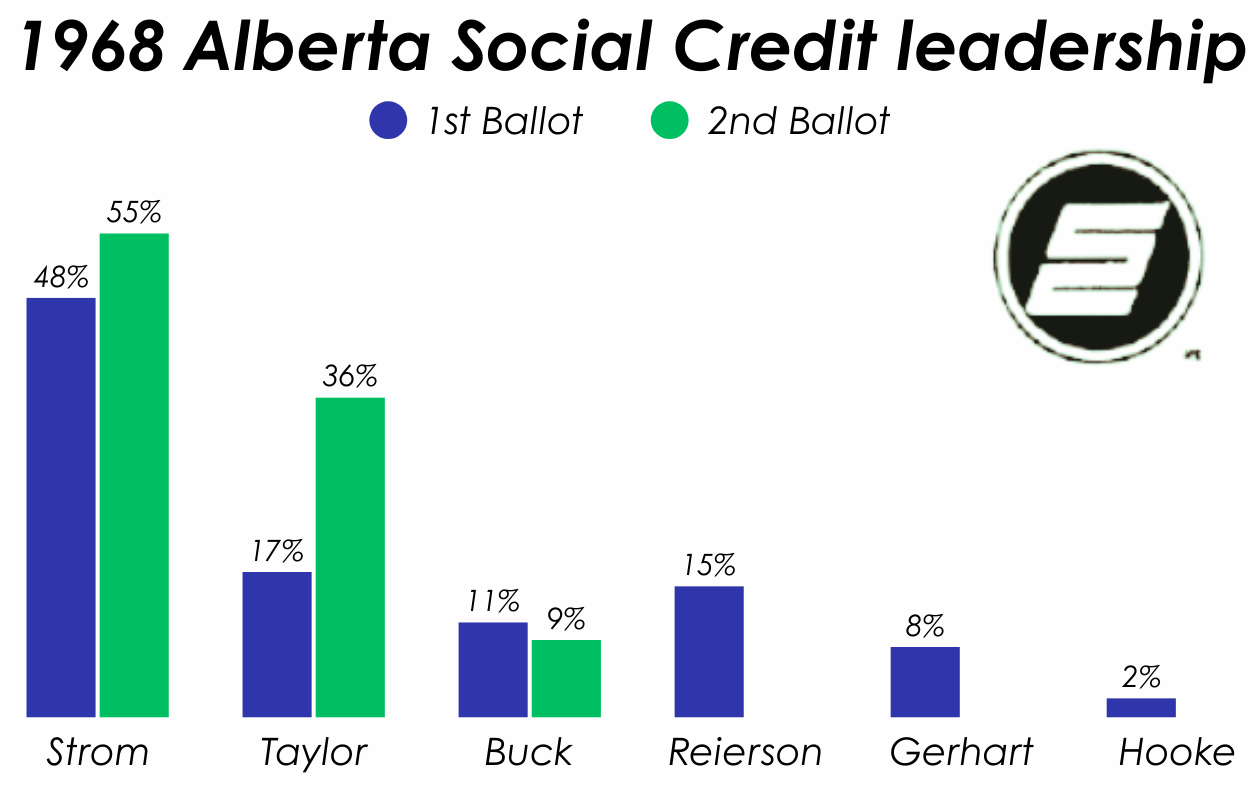
The first ballot played out as predicted, with Strom nearing but not obtaining a majority. He had 48% support of delegates, putting him well ahead of Taylor and Reierson, who had 17% and 15%, respectively. Buck finished fourth with 11%, followed by Gerhart and Hooke at 8% and 2%.
Hooke, who had already withdrawn when he endorsed Reierson, was automatically removed from the ballot. Gerhart also withdrew his name. Buck didn’t want to bow out, but Reierson made the decision to throw his support to Taylor, who was best positioned to block Strom (even if unlikely). Reierson’s attempt to announce his withdrawal and endorsement of Taylor, however, was blocked by party president Orvis Kennedy. Only after a shoving and shouting match did Reierson get to the stage.
It didn’t make much of a difference — though Taylor did indeed pick up a lot of support on the second ballot. By a greater than three-to-one margin, Taylor gained more votes than Strom on that second ballot. But Strom didn’t need many more votes to win, and prevailed on the second ballot with 55% to Taylor’s 36%.
On paper, Strom was taking over a party in pretty good shape. The Socreds controlled a commanding majority in the legislature and had done so for over 30 years. But the Social Credit League was a creaking old machine ill-prepared for modern political campaigns. It would turn out that the Socreds needed more than just a change at the top to keep up.
MILESTONE WATCH
Since it was first created from the merger of the PCs and the Alliance in 2003, the modern Conservative Party has had only four permanent leaders. And, on Tuesday, Pierre Poilievre will move up the ranks to be the second longest serving leader of that party, surpassing Andrew Scheer. On the table of leaders that includes all predecessor parties to the Conservatives, however, Poilievre ranks 15th.
That’s it for the Weekly Writ this week. The next episode of The Numbers will be dropping on Tuesday. The episode will land in your inbox but you can also find it on Apple Podcasts and other podcasting apps. If you want to get access to bonus and ad-free episodes, become a Patron here!
How many tossups do the Conservatives have?