


Welcome to the Weekly Writ, a round-up of the latest federal and provincial polls, election news and political history that lands in your inbox every Thursday morning.
François Legault’s resignation yesterday came as a surprise. Even when the announcement went out that the premier would be holding a news conference only a few hours later in the morning, it wasn’t known for certain what he would have to say.
In the end, though, his resignation was all but inevitable. The only surprise was that it took this long.
Legault’s Coalition Avenir Québec government looked unbeatable only a few years ago. His opposition was divided and weak, while Legault had ensconced himself in the centre of Quebec’s politics — not too federalist, not too sovereignist. Focused on the economy and the protection of Quebec’s culture and the French language, his party was the porridge that was just right.
But then the bottom fell out. The CAQ hasn’t led in a single poll in Quebec since October 2023 and the numbers just kept getting worse. A Pallas Data published this week put the party at only 11% support, tied for fourth with the small left-wing party, Québec Solidaire. Only 12% of Quebecers said they had a favourable opinion of Legault, while 75% said they had an unfavourable one. The CAQ was on track to being potentially wiped off the electoral map in Quebec’s provincial election in October.
Not even Justin Trudeau’s numbers were that bad when he threw in the towel a year ago.
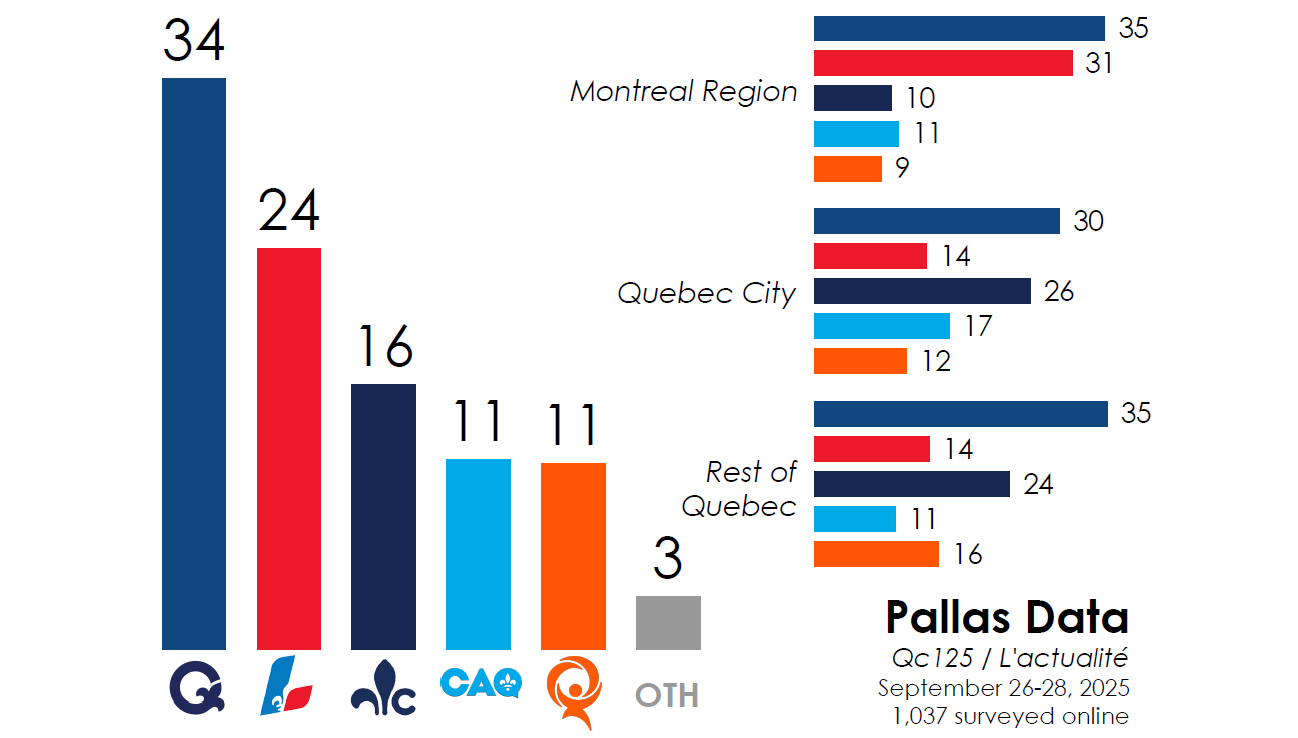
At some point, a change of leadership becomes the only option available to a governing party. The CAQ had reached that point a long time ago. Legault has left only a short amount of time for his successor before the scheduled fall election. But now that Legault is stepping aside the CAQ might have some hope that it could survive the vote.
Though he is leaving at the very lowest point of his premiership, Legault nevertheless has been an impactful premier in Quebec. The Coalition Avenir Québec is a party he created in 2011. Within seven years (and three elections), he took the CAQ from birth to government. That’s no small feat.
His victory in the 2018 election demonstrated that a third way between the old federalist-sovereignist divide in Quebec was viable. That win was the first by any party other than the Quebec Liberals or the Parti Québécois since 1966. Legault and the CAQ was successful in threading the needle between the two options without sparking a backlash — though the CAQ is currently deeply unpopular, its option is not. Support for sovereignty hasn’t risen over the course of Legault’s government. If anything, it has slipped.
Legault’s record in government is mixed. He led Quebec through the pandemic relatively well, maintaining high levels of personal popularity throughout 2020 and 2021 and winning a landslide victory in 2022. Quebec’s economy improved over his time in office as well.
But Quebecers grew tired of the messager. The comforting father-figure tone that Legault adopted during the pandemic became condescending and arrogant after it, and the CAQ’s reputation as a party of economy-focused business managers was tarnished after a series of gaffes (such as paying the Los Angeles Kings millions of dollars to play two exhibition game in Quebec City) and outright failures (Northvolt, SAAQclic) blew up in the government’s face. It wasn’t long before Quebecers started tuning out Legault, and started tuning in to the Parti Québécois, the only opposition option that seemed like a viable alternative.
So now the CAQ is about to embark on its first-ever leadership race. Founded by Legault, the CAQ has had no other leader and the party’s constitution even mentions that Legault is its leader. The parameters of this race should be settled upon shortly (if they haven’t been already by the time you’re reading this, as the party’s executive was slated to meet last evening).
The rules of the game will be determinative in deciding how it will be played, but the choice that the CAQ’s members have ahead of them will be a fascinating one to watch. Will Legault’s replacement be someone from within the government — such as high-profile cabinet ministers like Simon Jolin-Barrette, Sonia LeBel, Christine Fréchette or Geneviève Guilbault, to name a few — who has links to the party’s existing membership base (but also carries the government’s existing baggage), or will it be someone from the outside — like former ADQ leader Mario Dumont? Maybe even someone from Ottawa?
The job is not without its perks. Even if it might only be for a few months, being premier puts one in rare company. If the next leader is not able to save the government, they might still be able to save the party and hope to make a comeback in the future.
There is certainly an opportunity for the next leader of the CAQ, even if the odds of success are slim.
The Pallas poll suggests that Quebecers are not showing any particular enthusiasm for the options on the table. While Legault’s personal ratings were abysmal, none of the other leaders were above water. Conservative leader Éric Duhaime was a net -41, while QS co-leader Ruba Ghazal was a net -26. Charles Milliard, the presumed next leader of the Quebec Liberals, was a net -13. Even Paul St-Pierre Plamondon, whose PQ leads in the polls, was a net -8.
This suggests that the CAQ’s low polling numbers reflect more of a rejection of Legault (and the CAQ government) than they do an embrace of the Parti Québecois, Liberals or Conservatives. With a change of leadership, voters who were unsatisfied with their options — but certain that they didn’t want to see Legault re-elected — might give the CAQ another look.
It’s not as crazy as it sounds. The federal Liberals looked doomed until Mark Carney stepped forward. It’s doubtful that there is someone within the CAQ’s ranks that could pull off a Carney-esque rehabilitation for the party, but it is possible to imagine that Legault’s successor could save enough of the furniture for the CAQ to ensure the party’s continued survival and prevent the Parti Québécois from winning a majority government.
The next election could prove to be far more competitive and unpredictable than expected. Of course, the successor to Legault might do no better. But it is hard to imagine they could do much worse. The Quebec political scene in 2026 just got much more interesting.
The first Weekly Writ of the month is free to all subscribers. If you’d like to receive access to it every Thursday and haven’t already upgraded, you can do so right here!
Already a paid subscriber? Today’s your last day to get your entries in for the 2026 Prediction Contest!
Now, to what is in this week’s instalment of the Weekly Writ:
News on Chrystia Freeland’s resignation and what it could mean for the Liberals’ upcoming byelection schedule, as well as some changes to the governing caucuses in Alberta and Quebec and a trio of leadership races.
Polls suggest Mark Carney’s Liberals might be getting blocked by the Bloc in Quebec. Plus, new numbers on Doug Ford’s handling of U.S. relations, Canadians’ views on Venezuela, Albertans’ views on separation and where things stand in Nova Scotia.
#EveryElectionProject: The 1966 Alberta Liberal leadership contest.
Upcoming milestone for Yves-François Blanchet.
NEWS AND ANALYSIS
Freeland vacates seat, with more to come?
On Friday, Chrystia Freeland officially resigned her Toronto seat of University–Rosedale. The clock has now started ticking on when the byelection to fill the vacancy can be held.
Freeland’s resignation was foreseen ever since she announced she’d become the warden of Rhodes House and the CEO of the Rhodes Trust this summer. It became more pressing when she was also named an economic advisor to Ukraine. While the Liberal government is very supportive of Ukraine, having a sitting MP in the House of Commons also advise a foreign government was simply untenable.
But now the math in the House has become a bit trickier for Mark Carney. Prior to Freeland’s resignation, he was one seat shy of a majority government with 171 votes (including the Speaker) against 172 on the opposition benches. Another floor-crosser would have put the House into a tie that would be broken in the government’s favour by the Speaker. Now, one floor-crosser wouldn’t cut it.
So, unless we’re about to see multiple opposition MPs move across the floor, the Liberals will want to get the University–Rosedale byelection done with as soon as possible. The writ could be dropped as early as January 20 (as there is an 11 day waiting period from resignation-to-writ drop) and the vote held as early as March 2.
We could be into a byelection campaign within a few days time.
Except Freeland’s seat might not be the only one to be vacated in the short term.
There are three other vacancies that we expect to occur within the next few months. Jonathan Wilkinson (North Vancouver–Capilano) and Bill Blair (Scarborough Southwest) have long been rumoured to be headed to the diplomatic circuit, while Matt Jeneroux (Edmonton Riverbend) — who hasn’t cast a vote in the House since the brouhaha around the budget and Chris d’Entremont’s floor-crossing — has indicated he will resign by the spring.
The Liberals don’t have any particular need to worry about Edmonton Riverbend if Jeneroux continues to be a no-show on votes, as it is effectively one less vote against the government whether or not it is vacant. But vacancies in University–Rosedale, North Vancouver–Capilano and Scarborough Southwest will be worth worrying about. If the Liberals want to have them filled as soon as possible — assuming Wilkinson and Blair won’t hang around through to the summer — then we might expect some resignations from these two very soon. By my reckoning, it should already be too late to try to bundle all three of these byelections into one day of voting on March 2.
While the Liberals shouldn’t take anything for granted, all three of these seats are very safe. Yes, we all remember what happened in Toronto–St. Paul’s and LaSalle–Émard–Verdun in 2024, when the Liberals lost what were supposed to be strongholds. But the polling trends indicated losses in these two seats were at least within the realm of possibility at the time. There’s nothing in the polls that suggests the Liberals should be overly worried in any three of these seats.
What will be interesting to see, however, is who the Liberals nominate. There weren’t a great deal of candidates who ran in the last election that were obviously hand-picked by Mark Carney. He didn’t have a lot of time to recruit high-profile candidates. And the prospects that any candidates he did recruit would certainly find themselves on the government benches and potentially around the cabinet table weren’t nearly as good as they are right now, and especially in these three ridings.
Once we know the date in University–Rosedale and the situation in these other seats, we can delve a little bit more into the electoral stakes for each of the parties. But, for now, the thing to watch might simply be when any new vacancies will emerge — and who will step up to fill them.
ELECTION NEWS BRIEFS
LEADERSHIP NEWS - Since the Weekly Writ last went out, there have been a few developments on the provincial leadership front. We still don’t have any dates for the B.C. Conservative leadership contest, but we know that Conservative MP Aaron Gunn will not be running. Declaring their intention to run, however, are businessman (and former Conservative candidate) Yuri Fulmer, commentator Caroline Elliott and Conservative MLA Sheldon Clare. We also don’t have a date for the Ontario Liberal leadership, but we have updates from three of those who ran last time. Liberal MP (and runner-up in 2023) Nate Erskine-Smith is readying a team for another potential run, while Liberal MPP (and fourth-place finisher) Ted Hsu is out. Also out? Bonnie Crombie, who officially resigned her position on Wednesday. Finally, the Quebec Liberals will choose their next leader on March 14. Charles Milliard, the close runner-up to Pablo Rodriguez, has officially launched his campaign, while Mario Roy, who had a whopping 0.8% of the vote last year, also intends to run again.
SCHULZ TO RESIGN - Rebecca Schulz, Calgary Shaw MLA and environment minister in Danielle Smith’s UCP government, resigned from cabinet just before the new year and will resign her seat in the spring.
CAQ LOSES ANOTHER MNA - François Tremblay, the MNA for Dubuc, has quit the CAQ caucus and will sit as an Independent after being arrested for drinking and driving last week. He was driving nearly twice over the legal limit and ran into a fence. There are now 10 Independent MNAs in the National Assembly, most of them former caquistes.
POLLING HIGHLIGHTS
Does Carney have a Quebec problem?
There have only been a few polls published over the holidays. They were the trackers being run by Liaison Strategies and Nanos Research. They showed little real change over the last few weeks, with both giving the Liberals 39% and the Conservatives 36% support, followed by the NDP at between 11% and 12%.
But both polls also show something that other surveys were picking up before the holidays: a bump for the Bloc that could cause some trouble for Mark Carney.
On average, the Liberals are scoring around 38% support in Quebec. The Bloc Québécois is not far behind at 35%, with the Conservatives pulling up the rear at around 17%. Compared to the last election, this represents a drop of five points for the Liberals and six points for the Conservatives, with the Bloc up seven points.
As a result of this shift, the Liberals are projected to win 35 seats in the province, with the Bloc taking 34 and the Conservatives being reduced to just eight.
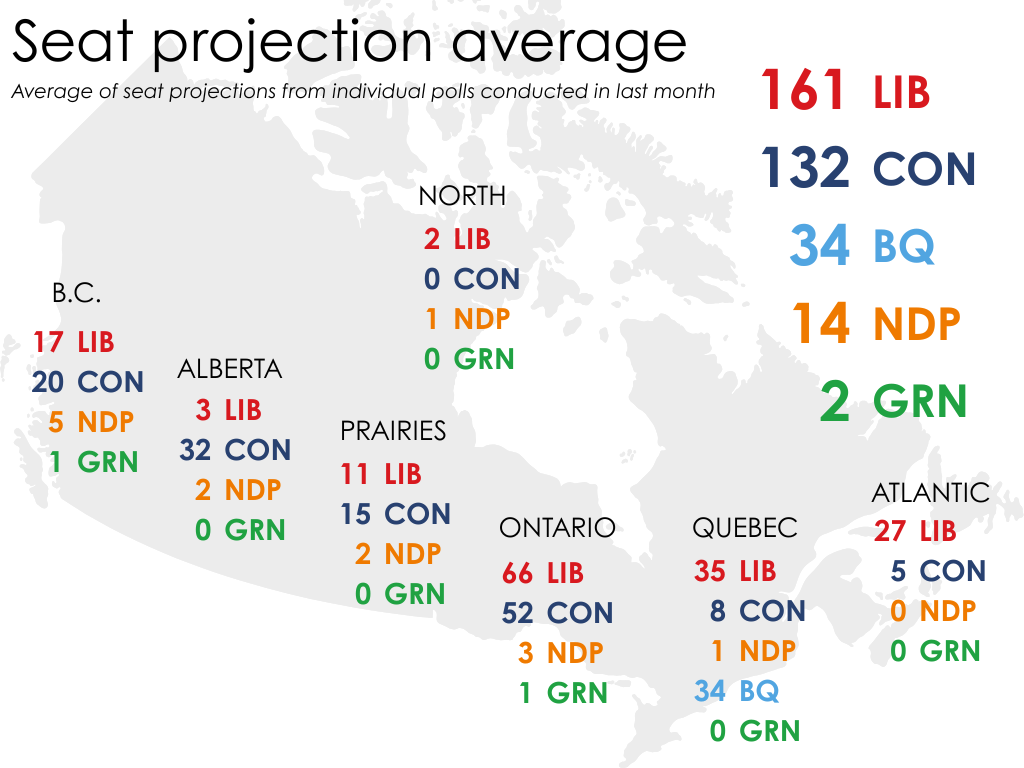
This means the Liberals would lose nine seats in Quebec and the Conservatives would drop three, boosting the Bloc by 12. The party is projected to be within only one of winning the most seats in Quebec, something the Bloc hasn’t done since the 2008 federal election.
There’s lots of talk about how the Carney Liberals could secure a majority with just a couple of more floor-crossers. But a new election would potentially put them much further back of the 172-seat threshold — and a lot of that is due to Quebec.
This isn’t just a few polls picking up a new trend. With the exception of the last Pallas poll of 2025 (which had the Liberals at 40%), the most recent poll from every major pollster has the Liberals below 40% and the Bloc above 30% in Quebec. The result in April 2025 was 43% for the Liberals and 28% for the Bloc. That’s an impactful shift.
What is driving it is not entirely clear. This isn’t just disappointment with the Carney government as the Conservatives have also taken a hit. But the shine has come off of Carney a little in the province. In its most recent poll, Liaison found Carney’s approval rating sitting at 54% in Quebec. His disapproval was at 36%. Those are good numbers and Carney is polling well above his own party, but Liaison’s pre-budget poll in early November had Carney’s approval at 63% in Quebec.
In the run-up to Pierre Poilievre’s leadership vote at the end of January, there will be a lot of focus on the Conservatives’ polling numbers. But we should also be keeping an eye on what’s happening with the Liberals in Quebec — if the Liberals can’t engineer a majority in the House, the polls in Quebec could be determinative of whether the Liberals try to win a majority at the ballot box in 2026.
POLLING NEWS BRIEFS
FORD V. TRUMP - New polling from Nanos Research suggests that 42% of Canadians give Ontario Premier Doug Ford good or very good ratings on how he has handled the “U.S. trade dispute”. Only 27% give him a poor or very poor rating. But his numbers are better outside of Ontario than in it — Ford was a net +8.5 in Ontario, compared to +11 in Quebec, +12 in Alberta and the Prairies, +33 in Atlantic Canada and +35 in British Columbia. Abacus Data, meanwhile, shows the Ontario PCs continuing to lead in the province with 48%, followed by the Liberals and NDP at 22% and 19%, respectively.
CANADIANS ON VENEZUELA - A new poll by Léger shows that only 23% of Canadians think the U.S. military operation in Venezuela was a good thing “as Maduro was a corrupt dictator and his government was hurting ordinary Venezuelans”, while 53% feel that it was a bad thing “because it is a serious violation of a country’s sovereignty and sets a terrible precedent for other countries to do the same”. There was a partisan divide on this, with around 70% of Liberals, New Democrats and Bloc supporters thinking it was a bad thing, twice the percentage of Conservative supporters. A plurality of Conservative voters (46%) think it was a good thing. A majority of supporters of all parties, however, believe the primary motivation was oil.
ALBERTANS KEEN ON CANADA - Polling by Pollara and Research Co. suggests support for Alberta independence remains relatively low in the province. Pollara put support for separation at just 19% (75% against) and concentrated among UCP voters (40% for, 53% against). Research Co. showed that just 17% of Albertans strongly support Alberta becoming an independent country, with another 14% saying they moderately support the idea (49% strongly oppose, 13% moderately oppose). Research found the same partisan split on this question as Pollara.
HOUSTON HOLDING - According to a new poll from Liaison Strategies, Tim Houston’s governing PCs continue to lead in Nova Scotia with 50% support. The NDP under Claudia Chender is second with 31%, followed by the Liberals at 18%. The poll gives the NDP 40% support in Halifax, a gain of six points since the 2024 election. The PCs have dropped 10 points to 31% in the provincial capital. In the rest of Nova Scotia, however, the PCs have gained four points and lead with 65% to the NDP’s 23%. Liaison gives Houston a 56% approval rating, with 38% of Nova Scotians polled disapproving of the premier.
12-MONTH ELECTORAL CALENDAR
February 7: PEI Progressive Conservative leadership
Candidates: Rob Lantz, Mark Ledwell
March 14: Quebec Liberal leadership
Candidates: Charles Milliard, Mario Roy
March 29: Federal NDP leadership
Candidates: Rob Ashton, Tanille Johnston, Avi Lewis, Heather McPherson, Tony McQuail
May 11: Municipal elections in New Brunswick
October 5: Quebec provincial election
October 17: New Brunswick Progressive Conservative leadership
Candidates: Daniel Allain
October 17: Municipal elections in British Columbia
October 26: Municipal elections in Ontario
October 28: Municipal elections in Manitoba
November 2: Municipal elections in Prince Edward Island
November 9: Municipal elections in Saskatchewan
November 28: Nova Scotia Liberal leadership
Byelections yet to be scheduled
QC - Chicoutimi (to be called by March)
CA - University–Rosedale (to be called by July)
CA - Edmonton Riverbend (resignation pending)
AB - Calgary Shaw (resignation pending)
Party leadership dates yet to be set
Federal Greens (Elizabeth May announced on August 19, 2025)
Ontario Liberals (Bonnie Crombie announced on September 14, 2025)
B.C. Conservatives (John Rustad resigned on December 4, 2025)
Coalition Avenir Québec (François Legault announced on January 14, 2026)
ON THIS DAY in the #EveryElectionProject
Alberta Liberals choose a leader — for a little while
January 15, 1966
This was originally published on January 10, 2024.
Politics was changing in the 1960s. Quebec was in the midst of the Quiet Revolution and the United States was reeling from first the election, and then the assassination, of John F. Kennedy. Student-led protests and calls for change emanating from south of the border were being heard in Canada, too, and before the decade was over the country would have its own youthful-seeming, mould-breaking prime minister.
But one place where politics was still very old-fashioned, at least for the time being, was Alberta.
The province had been governed by the Depression-era Social Credit Party since 1935. Since 1943, the premier had been the unflashy, deeply Christian and solidly conservative Ernest Manning. It didn’t seem like that was going to change anytime soon.
The Socreds dominated Alberta politics, leaving little room for any real opposition. The tiny opposition that was elected in the 1963 election was led by Dave Hunter and the Liberals. They won all of two seats, taking 20% of the vote. The Socreds, by comparison, won 55% of ballots cast and 60 seats.
The extent of Manning’s dominance was so great that, in 1965, Hunter felt he had better prospects as a federal Liberal — even in Alberta. He resigned his provincial leadership and ran for Lester Pearson’s Liberals in the 1965 federal election, placing a distant second in his riding of Arthabaska.
But with the Alberta Liberals now searching for a leader, there was a bit of optimism around the party’s chances. Social Credit was increasingly showing its age, and when the Liberals mounted their leadership convention the Ottawa Citizen’s correspondent, James H. Gray, noted that “greying heads were notably absent from the convention platform and the convention floor”. This was a more youthful, forward-looking party than it had been before. It was certainly more youthful than the Socreds.
Alberta was changing. Another party had an opportunity to be the vehicle of that change, according to Gray.
“The Alberta population has changed drastically in the past 15 years,” he wrote. “The Socred proportion has been drastically reduced by the huge influx of outsiders and by the attrition of time. A good half the population knows nothing and cares less about the economic conditions that spawned Social Credit.”
There were two front runners for the Alberta Liberal leadership, which would be decided on January 15, 1966.
There was Calgary alderman Adrian Berry, who had ran for the federal Liberals in the last election, finishing a respectable (but still distant) second in Calgary North.
His main rival was Robert Russell of Edmonton, the former executive secretary of the provincial party. According to the Calgary Herald, he hadn’t “cut his chances any by having corsages handed out to the female delegates” of the Women’s Liberal Association, who gathered to hear from the contestants in the days ahead of the vote.
Also on the ballot was Richard Broughton of Ponoka and Wilbur Freeland of Peace River.
A farmer and a veteran of the Second World War, in a couple years Freeland would become the grandfather of Chrystia, the future federal finance minister. For now, though, he was an also-ran in this contest, an “outspoken advocate of left-wing policies, such as public ownership of power”, according to the Herald. Broughton also had little shot and it probably didn’t help that he spent the final days of the campaign on vacation in Mexico.
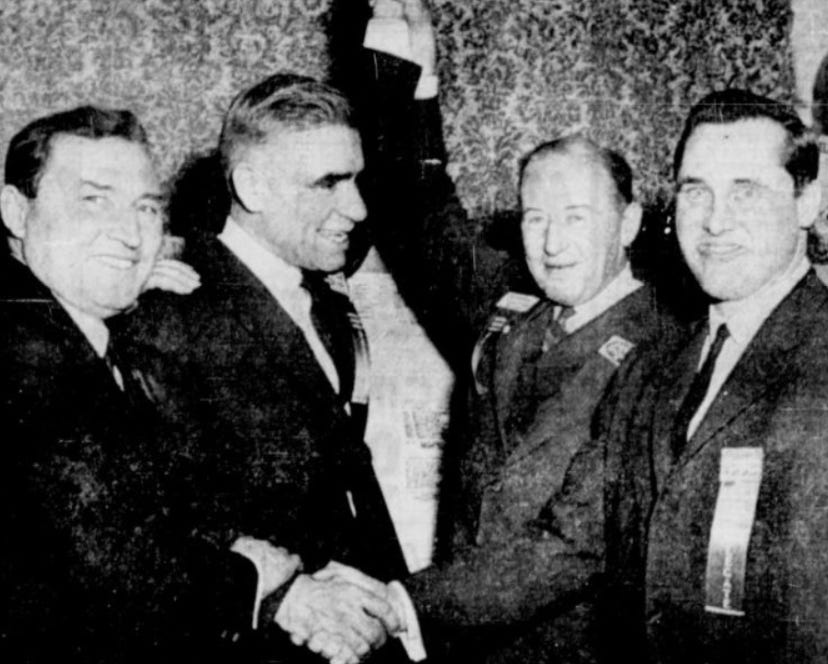
The convention in Calgary was well-attended, with some 1,000 voting delegates and observers present. The Alberta Liberals wanted to spice up the contest a little and adopted a voting system reminiscent of the American primaries — delegates would choose leaders from within their groups, and have those leaders announce which candidate their group would be backing.
Drawing a queen of spades from a deck of playing cards, Berry spoke first to the convention. He sharply criticized the Social Credit government but he didn’t spare the Liberal Party either, saying “I’m not impressed with our organization in this province.”
The voting system, meant to create excitement, instead sparked confusion, delays and recounts, taking some energy out of the event. The presence of the youth delegates was felt, however, when they voted to add lowering the drinking age to 18 and legalizing birth control to the party platform.
The first ballot ended in a tie, with both Berry and Russell taking 231 votes, each heavily backed by their respective Calgary and Edmonton bases. Freeland took just 78 votes, while Broughton had only 15.
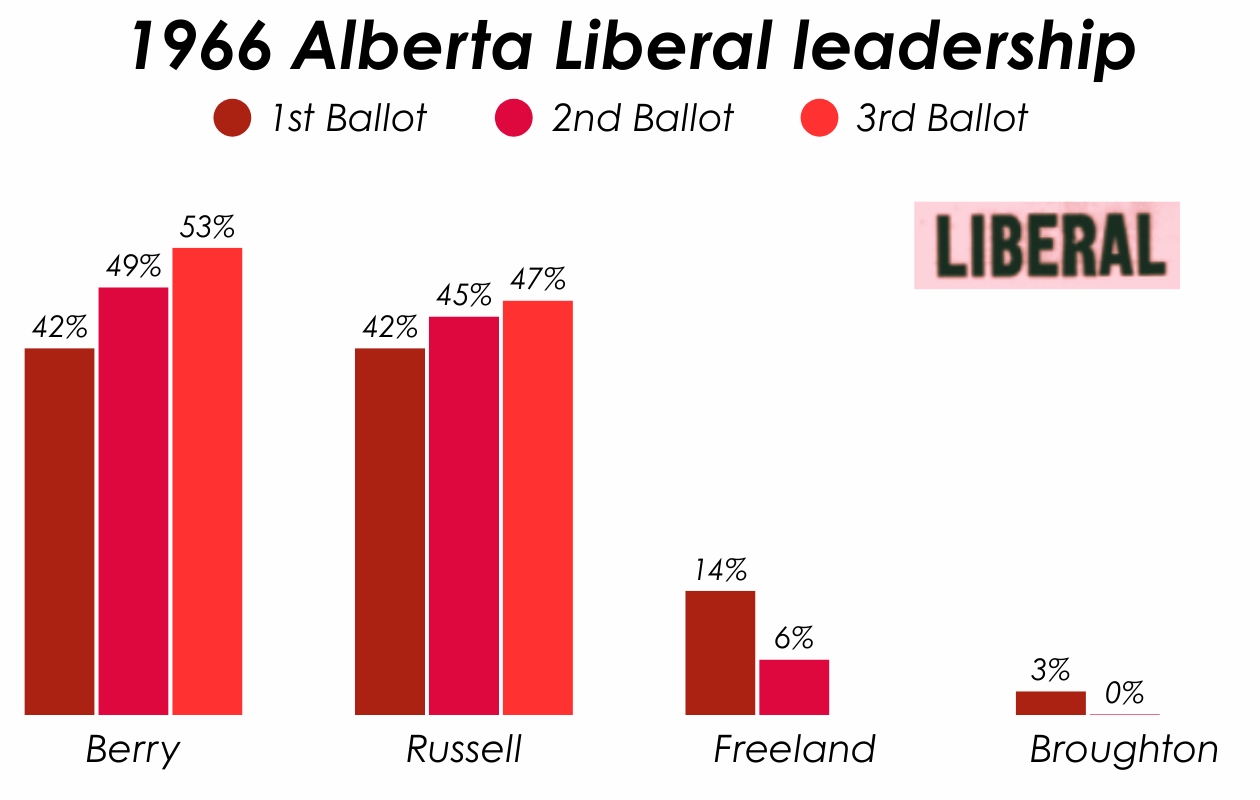
On the second ballot, Freeland’s support was cut nearly in half as most of his and Broughton’s backers went over to Berry. On the final ballot, Russell wasn’t able to pick up more than two votes to Berry’s 16, and that settled matters. Adrian Berry would be the new leader of the Liberals and the standard bearer for change in the province.
It wouldn’t last. Citing divisions with the party executive that made his position “untenable”, Berry resigned in November 1966. Michael Maccagno, who led the opposition in the legislature and who had been interim leader after Hunter’s resignation, resumed that role and kept it, leading an unprepared and divided party into the 1967 election held in May.
The unsteady Liberals weren’t able to become the vehicle of the new Alberta. Instead, it was Peter Lougheed and the Progressive Conservatives who displaced them, finishing second in the 1967 election with more seats than they had ever won since the formation of Social Credit. In 1971, the PCs would finally break the Socreds’ strangle-hold on the province — and the Liberals, now finally under Robert Russell, fell to just 1% of the vote.
MILESTONE WATCH
On Saturday, Yves-François Blanchet marks seven years as leader of the Bloc Québécois. He took over the then-moribund party in January 2019, leading it back to relevancy in the federal election later that year. In his three elections as leader of the party, the Bloc has averaged 28.7 seats and 30.7% of the vote in Quebec.
That’s it for the Weekly Writ this week. The next episode of The Numbers will be dropping on Tuesday. The episode will land in your inbox but you can also find it on Apple Podcasts and other podcasting apps. If you want to get access to bonus and ad-free episodes, become a Patron here!