


Welcome to the Weekly Writ, a round-up of the latest federal and provincial polls, election news and political history that lands in your inbox every Thursday morning.
This is a long, detailed post with many charts, so it might be too big for your email inbox. If that’s the case, you should have a link at the bottom of your email to read the entire thing. Or, you can read it all on The Writ website.
It’s often said that there is no single election in Canada. Instead, there are 343 of them — one for each individual riding.
While most of the focus of any campaign, as well as the bulk of a party’s spending, is national, the battles in each riding can make a real difference. And when the margins are tight, it is organization and money that can decide winners and losers.
The campaign reports for nearly every candidate who contested a seat in the 2025 federal election have been posted to the Elections Canada website. That means its time to delve into these results to help us a learn a little more about how that election unfolded.
We should get a few caveats out of the way before getting into it. A few candidates have either not yet filed or their filings have not yet been posted by Elections Canada. Roughly a dozen reports apiece for the Liberals, Conservatives and New Democrats are outstanding. So, the figures in this article represent about 97% of all candidates from the major parties. The second caveat is that I have come across a few transcription errors in the data. I’ve corrected them when they’ve been found, but it is possible that some errors have crept into the summarized results. Lastly, note that the spending figures are only for campaign expenses that are subject to the spending limit set by Elections Canada.
With that out of the way, let’s dive into the numbers.
Fundraising by candidates was down significantly from the last two elections, with the four major parties (plus the Greens and People’s Party) raising a combined $3.9 million at the riding level during the campaign. That’s down from $6.3 million in 2021 and $7.3 million in 2019. National fundraising was up this year compared to the last two election, so this might suggest that more candidates were directing their donors to the central party office than before.
Pierre Poilievre’s Conservatives raised the most money at the riding level at $2.1 million, followed by the Liberals at $817,000 and the NDP at $398,000. This was down from both 2019 and 2021 for all three parties.
If fundraising at the local level was down, spending was up significantly. Candidates for the six parties spent a combined $59.8 million in their ridings, up from $49.5 million in 2021 (and higher than the $54.1 million spent locally in 2019). This is in addition to the money spent at the national level. That means that the total spending for the Conservatives and Liberals, nationally and locally, comes in at $61 million and $58 million, respectively.
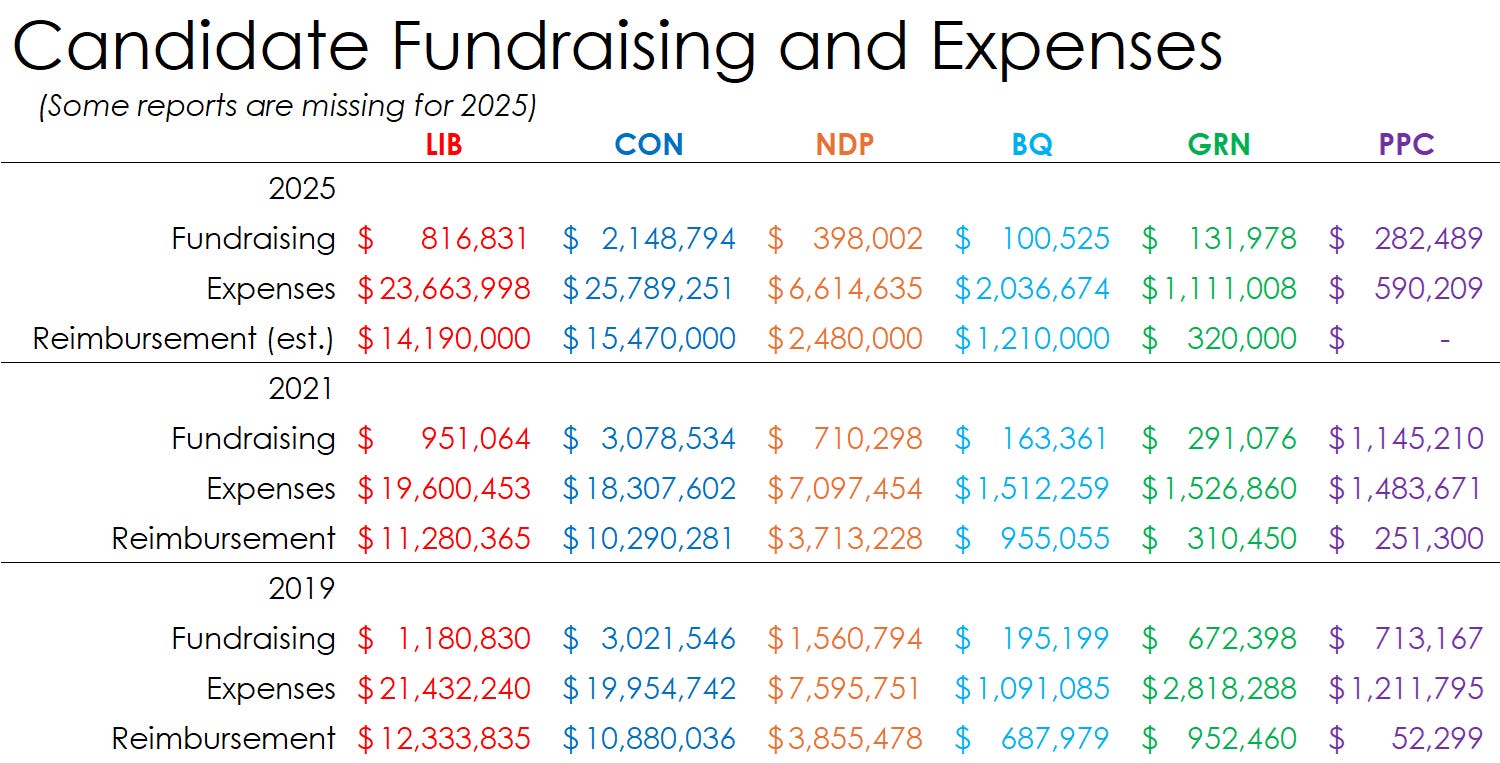
The Conservatives spent $25.8 million at the riding level, followed closely by Mark Carney’s Liberals at $23.7 million. That was up sharply from what was spent in 2021.
The NDP spent $6.6 million locally, down from over $7 million in the last two elections, while the Bloc spent just over $2 million at the riding level. That’s nearly double the amount that Bloc candidates spent in 2019.
The slide of both the Greens and PPC is showcased in these numbers. Green candidates spent $2.8 million in 2019 but just $1.1 million in 2025. The PPC, which spent $1.5 million locally in 2021, spent just $590,000 in 2025. Having failed to hit 10% of the vote in any riding, the PPC is slated to get none of its campaign expenses reimbursed.
Elections Canada reimburses 60% of a candidate’s expenses, as long as that candidate obtained at least 10% of the vote. The Liberals passed that threshold in all but one riding they contested (Souris–Moose Mountain), where their candidate spent all of $2,300. The Conservatives took less than 10% of the vote in the downtown Montreal ridings of Rosemont–La Petite-Patrie and Laurier–Sainte-Marie. Their returns show a combined expense of $24 in those ridings.
So, both parties will receive nearly the maximum reimbursement possible. I estimate it to be around $14.2 million for the Liberals and $15.5 million for the Conservatives. (The parties will also get 50% of their national campaign expenses reimbursed.)
The NDP failed to reach 10% in the vast majority of ridings and so will not receive a large reimbursement. However, the NDP concentrated its spending in ridings where it had decent support, so their reimbursement will still be around $2.5 million. That’ll be down more than $1 million from each of the last two campaigns, but is not as disastrous as it could have been — the NDP spent its money largely where it had a shot of winning a good chunk of the vote. The NDP’s reports show 214 ridings with expenses of $10,000 or less. By comparison, the Conservatives and Liberals spent more than that in all but 40 ridings or so.
A few seats stand out, however, as ones where the NDP spent a great deal of money without passing the 10% threshold. They are Ottawa West–Nepean ($109,000), Sudbury East–Manitoulin–Nickel Belt ($97,000), Spadina–Harbourfront ($88,000), London Centre ($79,000), and Vancouver Fraserview–South Burnaby ($71,000). While those are seats where the NDP would have normally had expectations of putting up a respectable performance, the party’s vote tanked in these ridings and those expenses will not be reimbursed.
Before diving deeper into the riding-level data, here’s what else you’ll find in this edition of the Weekly Writ:
We have a bit of news on the next Conservative campaign director, further upheaval in Quebec and some recall campaigns in Alberta.
Quiet week on the polling front, but we have some new national numbers as well as some polling on the NDP leadership contest and on the provincial scene in Quebec.
#EveryElectionProject: The 25th anniversary of the 2000 Canadian election.
Upcoming milestone for Doug Ford.
Now let’s take a look at how spending broke down at the provincial and individual riding level — and what it says about where the parties were focusing their efforts.