


Welcome to the Weekly Writ, a round-up of the latest federal and provincial polls, election news and political history that lands in your inbox every Thursday morning.
On Tuesday, the Liberals’ Government House Leader Steve MacKinnon expressed some worry that the budget might not get passed and so send the country into a fall election.
On Wednesday, Prime Minister Mark Carney met with opposition leaders and then made a speech outlining his budget plans and why it should be passed by the House of Commons.
While you’ll find few politicos in Ottawa who sincerely believe we’re going to have a second election in 2025, the odds of it happening are not zero. In all likelihood, one party or another will blink in this political game of chicken. The Liberals might include some concessions in their budget to get one of the other parties on board, or one of the other parties might find a rationale for ensuring the budget passes to avoid an election.
But parties are undoubtedly also weighing the pros and cons of a snap election and whether they outweigh the pros and cons of finding some compromise on the budget. What are those pros and cons — and who should worry most about heading back to the polls?
Also in this week’s instalment of the Weekly Writ:
News on the municipal results in Calgary and Edmonton and one last look at the results of the Newfoundland and Labrador election. Plus, more turmoil within B.C. Conservative ranks, a first entrant into the New Brunswick PC leadership race and a date is set for the first official NDP leadership debate.
Polls show trouble for François Legault, but also maybe for the Parti Québécois. Plus, new numbers on views on immigration, party standings in Ontario and B.C. and what to expect ahead of Quebec’s mayoral elections.
#EveryElectionProject: The 2004 Nova Scotia Liberal leadership contest.
Programming note: The Weekly Writ is taking a brief hiatus. It’ll be back on November 6. Have a safe and happy Halloween!
Two national polls were published over the last week. Abacus Data found the Conservatives at 41% and the Liberals at 40%, with the New Democrats in a distant third with 8%. The latest iteration of the four-week rolling poll from Nanos Research put the Liberals at 39% and the Conservatives at 37%, with the NDP sitting at 12%. In other words, these two polls show the leading parties effectively tied.
Another narrative in the polling comes from Léger, which published some numbers earlier this month. That poll had the Liberals ahead by six points, 44% to 38%.
Generally speaking, the polls conducted since the end of the summer have shown either a statistically insignificant gap between the Liberals and the Conservatives or a modest Liberal lead.
Using those two scenarios and plugging them into a seat projection model gives us an example of the two likely outcomes — or perhaps the outer ranges of the likely outcomes — of an election held today:
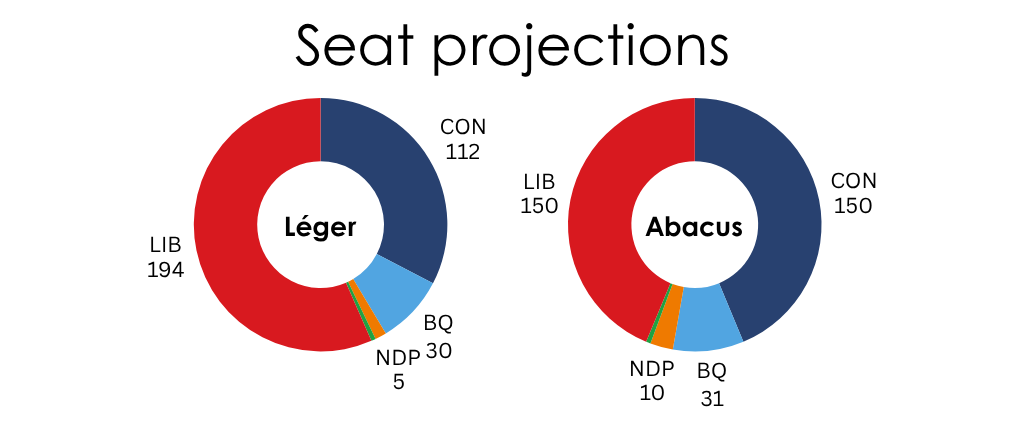
Of course, if the budget fails to pass the election will be held not today but instead in mid-December. But using these seat projections as our kicking-off point, let’s take a look at the pros and cons of such an election for each of the major parties.