


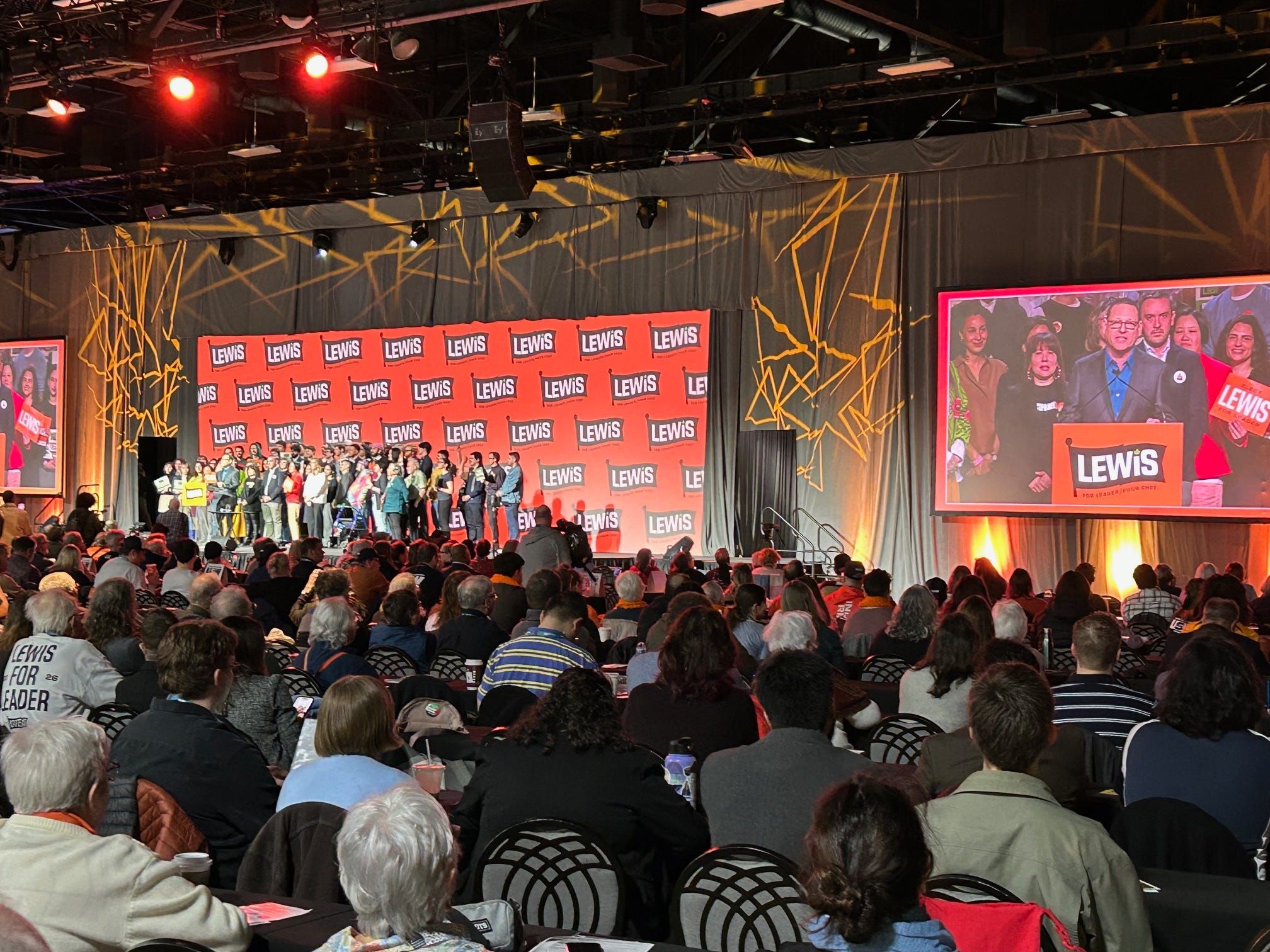
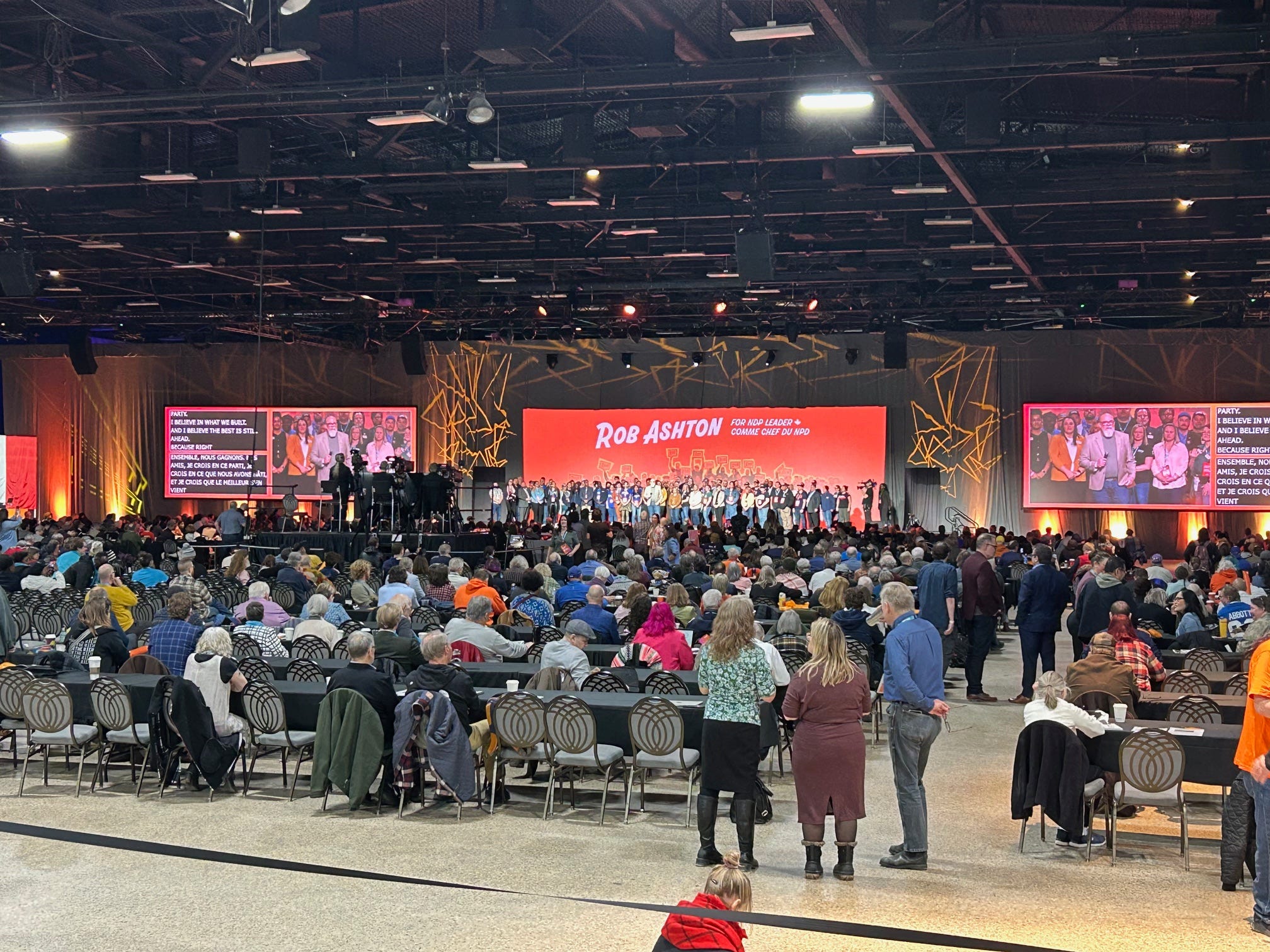
I’m writing from the floor of the NDP convention in Winnipeg, where nearly everyone seems to agree with what the only real source of data we have about this race suggests — that Avi Lewis will win the NDP leadership.
It seems to be the consensus view among most of the roughly 2,000 delegates that I’ve spoken with who have gathered here in Manitoba’s provincial capital for this convention. Some argue that a path still exists for one of the other candidates — usually Heather McPherson, sometimes Rob Ashton — but it’s hard to escape the impression that even many of those supporting his opponents have reconciled themselves to the idea that Lewis will win.
There’s good reason for it. As I’ve tracked throughout this leadership contest, Lewis has been a fundraising juggernaut, at least in the more modest fundraising context of the New Democrats. He’s raised more money than any NDP leadership candidate in any previous party contest (for which data exists) and he’s raising as much money as the rest of the field — combined.
The second interim reports published by Elections Canada today, the last set of data that will be published before the result is revealed tomorrow, shows that Lewis has raised over $1.4 million. That’s double the $700,000 that has been raised by McPherson. Ashton comes in third with $392,000.
The second interim report from the Tanille Johnston campaign was not available as of writing, but she reported $192,000 in her first interim report. Tony McQuail brings up the rear with $123,000 in fundraising.
As a share of every dollar that has been donated to these five candidates, Lewis leads the pack with 51%, followed by McPherson at 25%. Ashton, Johnston and McQuail trail with 14%, 7% and 4%, respectively.
This seems like a plausible first ballot result, though some here in Winnipeg (including the candidate himself) are expecting an even bigger number for Lewis on the first ballot.
Fundraising is not a perfectly predictive metric, but it is the only bit of data we have from this race. There are some 100,000 members of the party eligible to vote, but the New Democrats haven’t released where those numbers come from. As membership between the federal and provincial sections is shared, it’s anyone’s guess how many of the pre-existing members who had signed up to support their provincial sections will be engaged enough in this contest to cast a ballot. If they don’t, that’s likely to benefit Lewis, as it has been suggested that he has recruited the most new members. But even if they do vote in big numbers, it’s not a given that their vote will go in a bloc to one of the other candidates, especially since Lewis appears to have a solid base of support in both British Columbia and Ontario, where a significant portion of the members (if not a majority) call home.

One of the arguments I’ve heard in favour of a McPherson upset is the notion of quiet supporters — those who might be engaged more provincially and who might not have bothered to donate to her campaign but will quietly vote for her. This assumes that the Alberta and Saskatchewan sections, which have a lot of members, will vote in big numbers. It seems unlikely that they have enough members to push McPherson to 50%, but if we see a higher-than-expected number for McPherson on that first ballot, then this could plausibly be the reason.
The same kind of argument applies to Ashton, but with labour members substituted in for Alberta and Saskatchewan and with the extra caveat that he would have to finish ahead of McPherson to get her second choices. But the more these alternative paths are played out, the more they start to stretch credulity.
If we instead more safely assume that Lewis will win this and become the NDP’s new leader on Sunday, one of the challenges he will face is to keep the party united behind him. There is an undercurrent of resignation among those who are not supporting him here at this convention, particularly among those who have a longer history with the party or its provincial sections. This isn’t without reason — Lewis has run a campaign with elements of an anti-NDP-establishment bent to it. How he will get along with those long-time New Democrats, and especially the provincial sections who might not want to have their brand tied to Lewis’s more left-populist policies, is an open question.
While the most monumental task ahead of Lewis, should he win, will be to rebuild the party and get it ready to wage, and compete in, a national campaign with a robust organization and quality candidates from coast to coast, the more immediate challenge ahead of him might be a little closer to home.
If Avi Lewis wins this life long supporter won’t stick around. I’ll help start provincial party disaffiliation and name change movements.